| Tools: Save | Print | E-mail | Most Read |
| Challenges to Developing the Innovative Student |
| Adjust font size: |
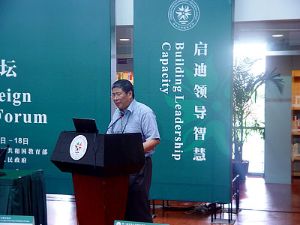
An oft-heard media question to participants at the ongoing Third Chinese-Foreign University Presidents Forum is: "What is your impression of the Chinese students studying in your university?" The forum is being held at the China Executive Leadership Academy in Shanghai. And the oft-heard, "standard" answer seems to be: "The Chinese students work very hard." That could be considered a compliment to the students, if it came from a Chinese teacher. However, the term "hardworking" rather sounds like a euphemism for "lacking in innovation," particularly at an international forum such as this one where 143 university presidents from home and abroad have gathered to discuss "innovative capacity building" in Chinese universities. This was the topic of focus at a panel discussion on scientific and technological innovation and university education held on Friday, where presidents from more than 30 Chinese universities -- both liberal arts universities, and science and engineering ones -- discussed the issue. "Higher education in China is still teacher- and curriculum-oriented. As a result, students are heavily burdened with demanding curricula and their innovative curiosity is stifled. Students' health conditions deteriorate and they have neither the time nor energy to conduct truly innovative research on their own," Zhu Qingshi, president of the University of Science and Technology of China (USTC), told his peers.
Zhu has been president of the USTC for eight years. One of his major tasks has been to reform his university's curriculum structure and to streamline the compulsory courses package. He said that he meets with teacher opposition in terms of the curriculum: "Teachers would tell me that a certain (compulsory) course cannot be moved because it is an inseparable part of the whole curriculum, or that cutting a certain course would affect the totality and continuity of the students' education and knowledge structure planned by the university." Zhu said that the practice of cramming and rote learning is outdated and should be discarded. Quoting a saying by Einstein to the effect that "university education is not always beneficial," Zhu called for the establishment of a student-centered mode of education, which enables a student to choose whichever courses he or she is interested in. He maintained that an innovative person is capable of self-study. Therefore, when a student is freed from knowledge cramming to pursue his interest, innovation will naturally follow. Zhu praised the credit system, which allows students certain freedom to choose their courses on condition that their total credits amount to the university's requirement. However, that is still far from enough. Besides a student-centered curriculum, Zhu is also committed to offering students more leeway to change majors: "If a student does not like his major but is unable to change to others, he would probably get nothing out of his university education." However, the choice should be two-way, Zhu added. One year after studying in the university, a student unhappy with his major is allowed to apply to study his preferred major. However, the faculty that offers the major has the final say based on the student's application. Zhu said that about 20 percent of students apply to change majors every year at the USTC. Since the university was set up in 1958, 33,000 students have graduated with various degrees, and 33 of them became academicians with either the Chinese Academy of Sciences or the Chinese Academy of Engineering, a remarkable rate of success.
Ji Baocheng, president of the Renmin University of China -- a liberal arts university -- said his university is offering its humanities majors science and engineering electives. Ji believes that this helps to build a solid base for innovation. For example, a student majoring in food quality management would benefit from courses in applied chemistry, and a sociology major will find strong statistical skills an advantage to his sociological research.
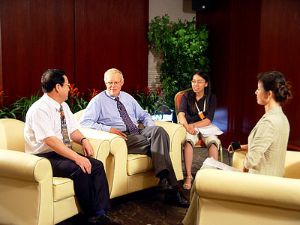
John Hennessy, president of Stanford University, strongly favors a diversified and comprehensive curriculum structure. During an exclusive interview with China Education TV on July 16, he said that his university offers its undergraduates a wide range of courses to help cultivate innovative capacity. A science and engineering student in Stanford is required to take courses in humanities, such as social science or philosophy. That would enable the student to think differently, he said.
Speaking in defense of the teacher- curriculum-oriented system, Vice Education Minister Zhang Xinsheng told a press conference on July 17 that significant progress that has been achieved in China's higher education institutions as a result. Chinese undergraduate students are generally well received by international universities for their solid basic knowledge. The most crucial thing is how to get the most out of the system, while reforming it gradually into a more pro-innovation one. Hennessy also employed the term "hardworking" to refer to Chinese students who first started their study in the American universities. However, he pointed out that when these Chinese students graduate, they typically become highly innovative. They are team players, they engage in discussion, and they embrace new ideas quickly. This is indicative of the fact that Chinese students do not lack innovative capacity. Rather, they lack an environment that can help them realize their full potential. Another thing in the way of Chinese students realizing their innovative capacity is the recruiting or enrolment system in colleges and universities. Every year, millions of Chinese high school students take the national college entrance examination, which consists of about four subjects. Admission is determined by total marks scored on these examinations. Such a system means that in China, where college education is still regarded as a prerequisite to a comparatively secure and bright future, the fate of a student who has undergone 11 years of education -- five years in primary school and another six years in middle school -- is decided by one single examination. This exam-oriented system leaves no room for innovative capacity building. Moreover, many students crack under the heavy demands and pressures attached to such an important examination. A girl who took the national college entrance examination in June reportedly made a mess of her exam papers on purpose, scribbling everything but the right answers. Gu Binglin, president of Tsinghua University, is critical of this system. Speaking to China Education TV on July 16, he pointed out that the Chinese education system is too much about rote learning. The core of education is not how much information a student can absorb, but whether the student is making constant progress through education. University presidents from China at least agree on this point: it is critical that the system be reformed if China is to realize the innovative capacity of its students. (China.org.cn by Wind Gu, July 17, 2006)
|

| Tools: Save | Print | E-mail | Most Read |
 |
| Related Stories |
|
| Product Directory China Search |
Country Search Hot Buys |
