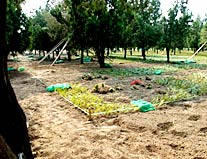
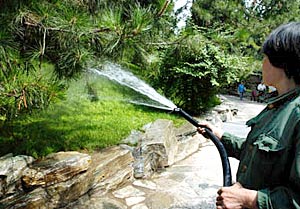
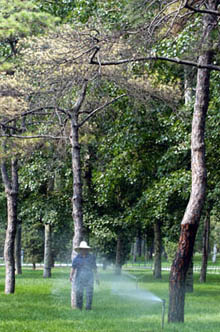
A gardener in Beijing's Tiantan Park said sadly, "Many trees that have stood for a thousand years are now dead." To cater for the growing habits of grasses imported from Europe and America, the park has had to introduce sprinkler irrigation across large areas of its gardens. But although this might be exactly what the new grasses need, it has had an adverse effect on the native pines that have watched silently over the park for so many years. They can only thrive in dryer conditions and many have died. Now the well intended innovations aimed at "greening" the park are being questioned by experts and public alike.
Alien grasses: good greenery or bad ecology?
In recent years, Tiantan Park, the Summer Palace, and Peking University's Yanyuan have replaced indigenous species with grasses native to foreign coastal areas. These new grasses need lots of water and this is something that Beijing is short of. Spray irrigation has been brought in to keep them healthy and green.
In fact, both citizens and experts have voiced their opposition to the imported grasses. Ecologists have said, "The move is wasteful in terms of both energy and money. It threatens our ancient woodlands and the ecological balance."
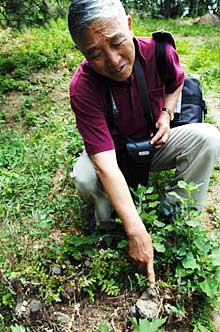
Sprinkling irrigation once or twice a week in Tiantan Park has resulted in too much moisture in the soil. Cui Haiting, a professor with the Institute of Environmental Engineering at Peking University found the herb Rumex gmelini Turcz growing among a group of pines. He said, "This herb belongs to humid areas, it should not be growing alongside the local pines."
Yang Zhenduo, former vice head at Tiantan Park, said that the pines were exhibiting hydrotropism. What this means is that the main locus of root growth tends to move towards moisture. Previously in dry soil this had meant strong deep roots but as moist soil is now concentrated near the surface, the pines are becoming increasingly shallow rooted. There is a price to pay for shallow roots in Beijing where strong winds blow in winter. Old pines now no longer so well anchored in the soil, are being blown over.
Environmental researchers have shown that these "cool-season" grasses pose a further threat to ancient woodlands for they lead to a less complex flora and a reduction in biodiversity.
"The pines in Tiantan Park and on Wanshou Hill in the Summer Palace have several hundred years of history," said Professor Cui. "The bushes and other plants that make up their undergrowth have settled into an environmental equilibrium over hundreds of years and are an integral and varied part of the pine and cypress forests."
According to the experts, there are some 50 species of plants in the pine and cypress forests of the Summer Palace and they have counted 78 in Tiantan Park.
At first sight a forest of trees may appear to be a biologically dull and uniform place but a good range of plants making up the undergrowth can add variety and maintain a balanced and diversified ecology. However the introduction of the "cool-season" foreign grasses is turning the woodlands into genuinely monotonous environments lacking even seasonal changes.
There have been knock on effects as new vegetation and soil moisture content resulting from spray irrigation have impacted on long-established animal habitats. Yang Zhenduo said, "Even earthworms are seldom seen in the places where the 'cool-season' grasses have been planted."
What's worse, the planting of "cool-season" grasses has actually caused soil erosion. In the Summer Palace, grass planting on the north slope of Wanshou Hill has been followed by the appearance of bare areas crisscrossed by gullies.
Article 14 of the 1982 Florence Charter of the International Council on Monuments and Sites (ICOMOS) states that:
"The historic garden must be preserved in appropriate surroundings. Any alteration to the physical environment which will endanger the ecological equilibrium must be prohibited. These applications are applicable to all aspects of the infrastructure, whether internal or external (drainage works, irrigation systems, roads, car parks, fences, caretaking facilities, visitors' amenities, etc.)."
Transplanting mature trees: a good move?
"The volume of greenery that can be provided by grassing is only one seventh to one twentieth of the volume that trees can provide. So transplanting trees into urban areas has become a quick cure for 'greening' the big cities," said Su Xuehen, a professor at the Beijing Forestry University.
Trees are being moved from the courtyards of villages, farmlands, mountain forests, and from "less important urban sections" to "important urban sections". Officials from the Beijing Garden Bureau said that there have been more and more "greening" project like this in recent years. The trees have been making their presence felt along the city's Airport Road, Fourth Ring Road, Chang'an Avenue, and in local communities. Most of the trees appearing there have been brought in from elsewhere.
"There's no stock of mature trees in the Beijing nurseries. These new trees reaching up into the skies so quickly are bought in from Shandong, Henan, Zhejiang and Jiangsu provinces," said Dong Xuexin, a businessman who helps the Beijing Garden Bureau source large trees for transplanting. "And half the trees are damaged in transit," he added.
Li Dihua, a botanist with the Institute of Environmental Engineering at Peking University, confirmed what Dong had said. "Trees that have lived for decades or perhaps even hundreds years in the one spot have put down deep roots and spread out thick foliage. They have developed a balanced relationship with the land they live in. Transplanting comes as a trauma adversely affecting their moisture content, roots and leaves, and being transported just increases the damage," said Li.
Providing the urban market with its "overnight greenery" has helped lots of people "grow rich overnight."
"A group of specialized traders has developed to service this market," said Dong. "Some make a living exclusively by pursuing the huge profits to be made in the purchase and resale of mature trees."
"Transplanting mature trees has become popular in China's large cities. One city government in a province in China's northwest has even said it will invite 500,000 mature trees into its city within the space of few months. Where will all the trees come from and how many will be damaged in transit?" said Dong.
Beautifying the cities: harmony or uniformity?
But is this beautifying of the cities, at the expense of disturbing their ecological balance and depleting natural resources elsewhere, really a success? Experts point out that real natural beauty is to be found in harmony and balance rather than in clothing the townscapes in a fresh evergreen uniform.
According to some experts, bringing in the "cool-season" grasses has not only reduced diversity but has also damaged the overall appearance of the landscape gardens.
Yang Zhenduo said that such species as Lagopsis supina, Chinese violet (Viola philippica), and mother chrysanthemum usually hold their leaves through to December in Tiantan Park. Their natural shades of green and range of sweet fragrances are always refreshing. But the green of the "cool-season" grasses doesn't match the dark green, red, gray and brown colors of the park. "It goes against artistic principles in terms of both balance and coordination," said Yang.
And there are other aspects of the drive to beautify the cities where the aesthetic perspectives are attracting criticism.
Prof. Su said that there is a current enthusiasm across the country for creating scenes of distant lands. For example Beijing has brought in tropical plants such as coconut palms, betel palms and other palm trees to add a taste of the scenery of far off south China to the northern capital. And for the sake of convenience, man-made trees and flowers have been "planted" on some of Beijing's squares and streets creating a sort of everlasting plastic springtime.
What is even more difficult to understand is that artificial plants are beginning to take root where the real ones are found.
"Leaflet banyans (Ficus indica) are easy to grow in south China. However, during the Kunming World Horticultural Exposition in 1999, a large artificial leaflet banyan, was 'planted' in the exposition garden," said Su Xuehen. "It cost several hundred thousand yuan and was made of polyvinyl chloride which can burn easily giving off poisonous fumes."
Su said, "Misunderstanding of aesthetic considerations has led to mistakes in the urban beautification drive. Deciduous woodlands have been replaced by evergreen ones, native bushes by strange flowers, and local grasses by alien ones. Moreover streets with artificial landscapes and the century squares exposed to the sun waste both energy and money."
Officials want to deliver quick results
"All officials hope to see achievements made during their term of office," said Su. "However, tree planting is an undertaking best viewed in the long-term and a desire for quick success can be counter-productive."
Experts put the blame for the current popularity of tree transplanting on a desire on the part of the officials to achieve quick results and instant improvements.
There is an old Chinese saying, "while earlier generations plant trees, posterity will enjoy their shade."
"Nowadays people are too impatient to wait for the shade. They want to plant trees today and enjoy the shade today," said Su. "Most horticultural managers are experts in gardening and fully understand the great harm that large scale transplanting is doing to nature. But they will choose to disregard what the experts are saying and carry out the work due to a strong sense of duty to their employers and out of loyalty to their superiors."
"Three groups of ginkgo trees are being planted in the current Beijing south city planning project," said Yang Zhenduo. "The trees will be 20 cm in diameter and they are to be planted only five meters apart. This will look really good at the time of planting. But at this spacing their branches will grow together in just a few years. Logically they should be put in eight to ten meters apart."
Yang speculates that the trees might be moving closer and closer together because design and construction fees are related to cost and increased costs mean higher fees.
Experts think that in the rapid process of urbanization, the policy makers must take a broader view and local interests should be subordinated to the general good. Only in this way can China's growing number of urban citizens be provided with a sustainable and healthy living environment.
(China.org.cn by Li Jingrong, July 14, 2004)