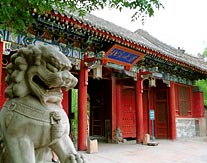
Peking University is always a news maker.
It most recently hit the headlines over a planned, radical overhaul of its faculty appointment and promotion policies.
For the top university management, the proposed reform program is in fact to carry on the legacy of Cai Yuanpei (1868-1940).
In its 105-year history, Peking University developed from a feudal academic institution of learning, and experienced its major reforms at the hands of Cai. In his career as an educational reformer, Cai synthesized valuable thoughts and ideas from China and the West, making Peking University a center for free and open scholarly thinking.
Of all the famous educators in the world, the present president of Peking University Xu Zhihong said he admires Cai the most, because Cai challenged the status quo.
The proposed reforms today also challenge the status quo. The new program will substantially impact on the career of almost every young and middle-aged faculty member at Peking University.
Lecturers and associate professors are expected to be most affected, since their life tenures are ended and up to a third of them may have to leave their current positions when the changes take effect.
The university's management claims they have taken everything into consideration when developing the reforms.
Two panels -- a "leading panel for personnel reform" and an "implementation panel for personnel reform" -- have been established to supervise and execute the reform program. The two panels, whose members are well-established professors of the university, worked out the first version of the new statute in early May after amending nine previous drafts. From May 12 on, they publicized the proposal on the university website to seek wider comment.
The responses were fierce. Letters of complaint or support piled up on the desks of the panel members and jammed the e-mail box of University President Xu Zhihong.
Almost all of the six major moves proposed in the draft of the reform program were heavily criticized, as well as powerfully defended.
On the basis of these responses, the panels produced a second version of the reform statute, which was again published for discussion on June 16, supplemented with a painstaking explanation of the reasons behind the six chief principles.
"If it is necessary, we will seek public feedback for a third time before the new policy is brought into operation," said Xu Zhihong in an open letter to all the faculty members and students of the school.
However, it seems this time the school authority is determined to bring about the reform, and will not budge on its principles.
"The program could never be perfect. But there are only two ways to carry out a reform: Do, or not do," Xu said.
Up or out
Of the six proposed moves, the one eliciting the most violent controversy is a regulation about eliminating unqualified faculty members.
Since the founding of New China, Peking University has maintained a personnel system that recruits its faculty members mostly from its own graduates -- these days, graduates with PhD degrees.
Once the graduates join the faculty, they have almost secured their positions with the university, one of the best in the country, for life.
Some view the system as a big iron rice bowl.
Zhang Weiying, an acclaimed 44-year-old economist and assistant to the president who serves as director in the implementation panel for personnel reform, said: "To pick out competent faculty members is a gamble. Some people who look promising at the start may turn out to have no potential or interest in scholarship later.
"Under the traditional system, the university has no chance to redress its mistakes," Zhang said. "The mediocre and the absent-minded can lead an easy life on campus, provided they meet the minimum standards in the annual assessment.
"We expect things will be different if the new regulation takes effect."
The new program borrows from the "up-or-out" rule observed by universities in the United States.
According to the provision, lecturers at Peking University will be given a contract term of six years, during which they have two opportunities to apply for promotion to associate professor. And associate professors will hold contract terms of nine or 12 years, during which they have two opportunities to apply for a professorship. Anyone who fails twice will be dismissed from the school the next year.
"Compared with the single chance American universities give their teachers, twice is already much more lenient," Zhang said.
No one has challenged the university's need to introduce machinery to weed out unqualified faculty.
"It really hurts my enthusiasm to see so many mediocre teachers working around me. That's definitely the first thing I wish to change," said Zheng Yefu, a professor with the Sociology Department of Renmin University of China, in a CCTV talk show on the topic on Sunday night.
However, some faculty members are apprehensive.
They argue that the reforms may drive faculty members to work towards short-term goals and discourage those who would otherwise concentrate undisturbed on teaching and research.
"Under the new policy, the university would not tolerate intellectuals like Cao Xueqin (1715-63), who silently developed the masterpiece A Dream of Red Mansions for 10 years," said a research fellow from Chinese Academy of Social Sciences.
In the notice board of the website of the university, an unidentified undergraduate student cited an example: "A teacher in our department received the most student votes for the 'best top 10 teachers' of Peking University. He has been a lecturer for 10 years simply because he feels it tiresome to go through the procedure to become an associate professor. Will we let him go after the reform?"
"In most cases, six years is long enough for a newly graduated doctor to demonstrate his capability," Zhang explained. "A smaller number of gifted people need a longer time to show their talent and they, upon convincing recommendations, should be exempted from the rule. But policy can only be designed in light of the most prevalent cases."
Another worry is whether fair competition, a prerequisite for the reforms to succeed, will be guaranteed.
"There has been too many human maneuvers, and too few objective, honest evaluations," said Dong Qiang, a young associate professor in the French Language and Literature Department.
"There have been abundant precedents, of talented, upright young scholars who were ignored for years, and of those adept in manipulation who get false reputations quickly and easily," Dong said.
"But then in many cases, the academic board has to depend on these false impressions to make a choice."
He feared that the university may lose some down-to-earth but humble young scholars.
Further improvement
The reform designers say they are very well aware of the criticisms.
"However, we can't wait for the overall academic environment to improve, and reform only then," said Xu Zhihong.
"On the contrary, we hope the change at Peking University will trigger a series of reforms throughout academic circles, and finally improve the whole academic environment in China."
To minimize chances of false assessments, the policy-designers will amend the statute in two ways.
One change requires the disbanding of any branch institute in Peking University if its rank in China falls out of the top 10 (for smaller majors, it could be the top 5).
According to the supplementary explanation, the regulation pressures the directors of branch institutes to make sure the truly competent stay.
In another provision, the code introduces a "board of professors" as an auxiliary force to evaluate the applicants for promotion. It regulates that the portfolio of any applicant must first be examined by the board of the professors.
Only when it achieves half of the votes there can it be sent to the university academic board for evaluation.
Most welcome the two regulations, though there are some voices questioning the feasibility of the first one.
"It would be hard to observe this rule," said Teng Wei, doctoral candidate in the Chinese Language and Literature Department of Peking University. "We still do not have an authoritative ranking system in China, and to disband an institute is much more serious than dismissing a staff member."
Life tenure
There is also debate over the fact that professors will be able to hold life tenures at the university, according to the new reform program.
Argued Yu Tianshu, an associate professor at the College of Foreign Languages in Peking University, said: "Peking University already has more than 1,000 professors, perhaps one of the largest numbers in the world.
"If these professors stay indefinitely, where is the room for new promotions? Of course, we could still create more tenured positions, but then we will have an even more turgid professor team."
Tan Yaozhi, a graduate student in the World Literature Institute, questioned whether the university should get rid of some of the unqualified professors, who, under the old promotion system, acquired their tenures not by academic accomplishments but by long years of waiting and innumerable applications.
Min Weifang, who obtained his PhD in education from Stanford University and served as executive vice-president of the Peking University before being appointed the university's Party secretary early this year, admitted there are indeed many unqualified professors.
However, he explained, "some of them have served the university for years and are rather old now.
It would be a real shock if we fired all of them -- that is more than we can afford to do."
Zhang Weiyin said: "In any reform, there is no best scheme -- only the next-to-the-best. If we can guarantee no more unqualified people become professors, the reform can be deemed a success."
Cradle of reforms
Peking University has been the cradle of many new thoughts and movements in China throughout its history.
The proposed reforms, as critics observe, might trigger changes across Chinese academia, marking a turning point in the development of China's scholarship.
Some leaders of important domestic academic institutes, such as Hou Zixing, president of Nankai University, and Zhu Qingshi, president of the University of Science and Technology of China, have expressed their support for Peking University's pioneers, and a wish to follow suit.
Some people are worried that over the course of the debate, the reforms will be diluted.
But Min Weifang assured them confidently: "This time, we won't let that happen."
(China Daily July 10, 2003)