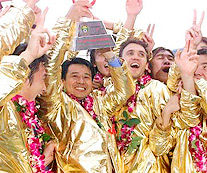
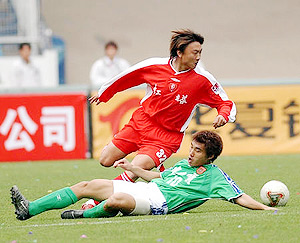
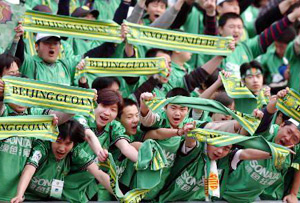
On November 30 the curtain finally came down on China's first division soccer league. Shanghai Shenhua was fortunate to have come out on top in 2003 despite losing 1 to 4 in a fiasco of a final round game against Shenzhen. The top 12 teams will now go on to become the founding clubs of the Chinese premier league to be launched next season. The new premier league will supersede ten controversial years of the old first division.
A high-risk investment
When first division soccer made its debut in 1994 it marked the introduction of professional soccer in China. As the country's most popular sport with hundreds of millions of followers it has enormous market potential. But ten years have already passed without a sound investment environment emerging. On the contrary, against a background of money culture, loss of faith and shortage of reserves, once golden soccer markets in Chengdu, Xi'an, Dalian and Jinan have shrunk one after another.
During the 2003 season the 15 first division clubs spent heavily. Each hoped to qualify for one of only 12 places up for grabs in next year's new premier league. In all the clubs invested some 400 million yuan (about US$50 million). Shanghai Shenhua and Shanghai International considered to be the bellwether clubs of the first division, each spent no less than 60 million yuan (about US$7.5 million) in purchasing players, paying salaries and bonuses etc. As the season progressed, investment by mid-level clubs passed the 30 million yuan mark (about US$3.75 million). Even those at the bottom of the rankings each committed no less than 20 million yuan (about US$2.5 million).
Annual investment in the sport has risen from one million yuan or so at the start of the ten years to tens of millions of yuan in the later years. According to incomplete statistics, the cumulative investment by first division clubs has been over 1.5 billion yuan (about US$187.5 million) in these years.
Lacking the cohesion of effective regulation, the first division has turned out to be a high-risk place to invest. In the absence of any real returns even longtime sponsor Pepsi Cola withdrew before its contract had run out. The past decade has witnessed a procession of sponsors like Wanda, Hongyuan, Songri, Taida, Quanxing and Ping'an bowing out regretfully.
A shortage of qualified players
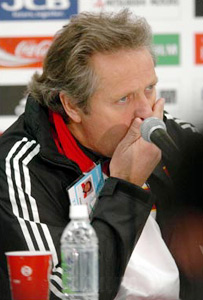
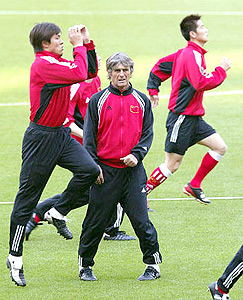
After the 2002 World Cup, Arie Haan succeeded Bora Milutinovic as the new head coach of the Chinese national soccer team. However, since the Dutchman took over the team the chronic shortage of international standard players has been a big headache for him.
The new national team was defeated by Japan and South Korea in the recent East Asian soccer championships held in Japan. With no obvious successor in sight, the team had to turn once again to 34-year-old striker Hao Haidong, making something of a mockery of ten years of Chinese first division soccer.
In retrospect, except for a few exceptions like Dalian Shide, Shanghai Shenhua and Shanghai International, most clubs have put profit before everything else and quality on the field has suffered.
Ten years ago the Chinese first division soccer league was launched, much encouraged by the prospect of soccer professionalism. At that time soccer inherited the players who had developed their game under the umbrella of the old planned economy. This generation of players included Hao Haidong, Fan Zhiyi and Li Bing who all played a prominent role on the soccer field back in those days. Surprisingly, ten years of professional first division soccer have failed to produce their successors to become the new mainstay of the national team.
A loss of faith
According to an online survey conducted jointly by CCTV and sina.com.cn, soccer fans questioned the credibility of the results of more than half of the first division matches in the 2003 season. In many cities, soccer enthusiasts boycotted live games in a wave of silent protest.
Back in the early 1990s there was an occasion when only some 10 spectators turned up for a match in south China's Guangdong Province. This was in the days of the National Football Championship (i.e. Chinese Football Association Cup). At that time, each team was paid an appearance fee of no more than 50 yuan (about US$6.25).
Beyond any shadow of a doubt, a decade of professional soccer has lined the pockets of Chinese soccer players, club managers and even referees. However this has taken place in the marked absence of commensurate improvements in either soccer skills on the pitch or in club administration.
To make matters worse, getting paid tens or even hundreds of times as much as ordinary salaried workers has just seemed to stimulate even greater avarice among some of those in China's soccer circles. As a result in recent years first division soccer has fallen into disrepute, its reputation tarnished by rigged matches and bribed referees.
People cannot but ask who should be held responsible for the mess China's soccer now finds itself in. Match organizers, administrators, soccer clubs, players, referees, fans or perhaps the media?
Time to turn over a new leaf
Systemic difficulties have militated against the effective development of the professional game. The Chinese first division soccer league is operated by the Chinese Football Association (CFA) conjointly with the Football Sport Management Center of the State General Administration of Sports funded by the central government. This dual responsibility mechanism has for some ten years headed up the richest sport in China. This system with its shared staff and two different signboards just cannot meet today's requirements of deepening reform.
The dual system has been beset with crises and seems predestined to issue regulations that are full of loopholes. The ups and downs of Chinese soccer over the past decade can be explained in terms of the policies and decisions of a system that has not yet been fully reformed.
Operational shortcomings could be forgiven in the early days of the introduction of market forces while those involved gained experience in unfamiliar roles. But now after a decade when China's market economy has been progressively improved, the soccer industry hasn't yet established the necessary framework to reap the benefits of its market. It still lacks effective regulatory and supervisory mechanisms. This represents a serious threat to what ought to be a bright future for the new Chinese premier league.
Ten years of professional soccer have come and gone. Though it is acknowledged to have successfully adopted other aspects of international practice it sits uncomfortably astride an uneasy mix of the market economy and the planned economy. This has led to unfortunate policy decisions that at times have seemed to verge on the absurd. A lack of continuity coupled with the apparently arbitrary nature of policy making have had a negative impact on the quality of China's first division soccer league products and have made for a high risk investment environment. People have lost confidence in the Chinese first division.
The lack of continuity in key policies affecting the game has impacted several times on the clubs' multi million investments. In the 2001 season there was promotion without relegation; then came 2002 with neither promotion nor relegation. Now 15 clubs have found themselves in contention for just 12 places in the new premier league. Three clubs have lost out in a big way on their investments.
The chaotic state of the first division with its troubled investment environment has developed in the wake of policy changes that have lacked transparency and the benefit of thorough market analysis.
The problems extend to the transfer of players. Here there have been arbitrary policies and administrative interventions in the market such as poorest team having first choice among the best players, free transfers, salary limits which exist in name only and limits set for appearances by the under-21s. It is difficult to understand the rationale behind such measures. They are counter-productive for they conflict with the normal mechanisms of the market economy.
A full decade has so far failed to produce excellence in Chinese professional soccer. If the new premier league turns out to be little more than a repackaging exercise then it will bring nothing but more of the same and disappointment for China's soccer fans.
The way out for Chinese soccer lies in deep reform. This can be realized by drawing on the experience of the English and Italian premier leagues and introducing truly commercial methods. The CFA should have a hands-on involvement only at the macro-control level and let professional soccer operate freely in line with market forces.
Soccer has not developed in China as it has in Japan or the Republic of Korea. Setting aside differences on the field, the main reason for China lagging behind resides at the systems level. China's new premier league cannot take to the field kitted out in the straight jacket of a bureaucratic hierarchy. It is a matter of life and death for Chinese soccer. This is the lesson to be learned from ten years of the first division.
Stagnation in the midfield of soccer reform
The greatest progress made during the decade of Chinese soccer reform is in the establishment of the system for league matches with clubs playing home and away games spurred on by thoughts of promotion and relegation. However there is also much cause for regret here as the ball of soccer reform is passed about in the midfield when it should be going for goal.
The Hongshankou Conference in Beijing in 1992 was a clear first milestone on the road to reform heralding in the ten years of first division soccer. Since the early days when the Guangdong Hongyuan Group acquired the ownership of the Guangdong Team from the CFA, some progress has certainly been made. Professional soccer clubs have emerged and have gone on to grow in both number and size. The game as a whole has expanded in China as the clubs developed.
However with the premier league poised to make its debut, people have to admit that certain unwelcome features have accompanied reform in its precursor the first division. Measures have been introduced apparently just for show or as shock therapy remedies.
In fact reform has meant making quite a fuss over minor issues, some of which have verged on the farcical. There was the cap on the number of foreign players on the field, the temporary suspension of promotion and relegation and the practice of league soccer matches conceding priority to the needs of other soccer fixtures even though the league was supposed to be at the very heart of soccer and fundamental to its development.
Last year, things became even more ridiculous with league rankings being decided by drawing lots. Reform still has a steep hill to climb.
Looking back with hindsight on a decade of professional first division soccer, falling spectator numbers represent the greatest source of loss. What really matters commercially is the paying fans and the needs of these fans is of prime importance in marketing.
However, the bustling and exciting scene in Chengdu, Xian, Beijing and Chongqing, the so-called "gold medal soccer markets" is now just yesterday's news. 1994 saw attendances at six league matches that topped the 150,000 mark.
The change of ownership of clubs year after year is yet another specter haunting Chinese soccer. When Beijing Guo'an changed its name to Beijing Xiandai, the last club still with its original name finally disappeared from first division soccer. Shanghai Zhongyuan even became Shanghai International in the middle of a league match.
The frequent changes of club ownership are not the hallmark of commercialization. On the contrary, they are indicative of risk taking, pursuit of wealth and fame and a lack of sustainable development.
Though the days of central government funding are long gone and state owned enterprises are no longer involved, commercially funded soccer is not yet on track. Market forces are not yet driving professional soccer forward effectively and the game is of limited attractiveness as an investment.
Soccer clubs have a long way to go before they take full control of their financial affairs. Decline at Beijing and Liaoning was closely related in each case to severe operational difficulties. Multi million operating costs and the huge salaries that the players can command not only exist in striking contrast to the commercial decline of the game they have also become obstacles to market reform.
Now as the first division is poised to be reborn as the premier league, the crying need is to further promote and deepen fundamental reform, to develop the club system and to improve the organization of match fixtures.
China's market economy as a whole is now well established and is moving on to a new phase of improvement. China's soccer has walked the professional, market orientated road for a decade but still retains too much of the planned economy in its systems, concepts and modus operandi.
Failing to keep up with the pace of the nation's economic reform has been the main shortcoming in market development in professional soccer in China. It has also been the source of many anomalies, unfair drawbacks and problems.
Soccer professionalism and market orientation share the common goal of a healthy industry and a sound culture for the future of the game. As long as the focus remains fixed on short term success and profit the game will lack a sound foundation. This is an important consideration influencing reform at the systems level.
The Chinese first division soccer league failed to live up to its high expectations. Shunning transparency it preferred to cover up its shortcomings. At the end of the day the fans are neither nostalgic about the old first division nor excited and optimistic about the new premier league. The reality of the game is that the Chinese first division soccer league is coming off the field having picked up plenty cuts, bruises and groans.
China's premier league is waiting on the sidelines to take part in a game that is sure to test its match readiness. Learning the lessons of the past decade, it must strengthen its defense while pushing reform forward from the midfield towards the goals.
The only viable future for progress and development in Chinese soccer lies in an orderly, professional industry responsive to the needs of its customers, the fans.
(China.org.cn by Li Jingrong and Shao Da, December 16, 2003)