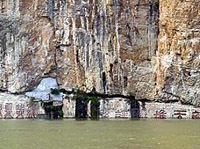
Many cliff inscriptions of 1,700 years old have been found in the Three Gorges area on the Yangtze River. Located on steep cliffs above torrential rapids, these carvings are hard to be reached or made rubbings of. That's why they could be reserved until today. When sailing on the river, one will have the chance to read this "rare book" and admire the wonderful legacy of art left by the Chinese ancestors. For historians, these inscriptions are messages passed down from remote antiquity, which reflect the changes of time.
Cliff carving has a very long history in China. It spread widely in the Qin (221-206 B.C.) and Han (206 B.C.-A.D.220) dynasties, flourished in the later period of the Han Dynasty and continued to develop during the Three Kingdoms (220-280) and Jin Dynasty (265-420). By the Sui (581-618) and Tang (618-907) dynasties, all events, big or small, were recorded with stone carvings. Later, stone inscriptions became increasingly prosperous and prevailed to every corner of China.
Combining words and images, the art of stone carving was widely used through all dynasties to record history, eulogize virtues and achievements, express beliefs and adoration, and convey affection. Today, research on stone inscriptions has become an important part of history studies in China.
The major cliff carvings existing in the Three Gorges area are from different dynasties, two from the Han Dynasty, one from the Jin Dynasty, seven from the Tang Dynasty, one from the Five Dynasties (907-960), eight from the Song Dynasty (960-1279), one from the Yuan Dynasty (1279-1368) and nine from the Ming Dynasty (1368-1644). They reflect the economic, political and social lives in different historical periods of China.
Buddha washing feet
Sailing upstream on the Yangtze River from Chongqing, you will soon see a laughing Buddha on the bank near E'gongyan Bridge in Jicui Village. Sitting cross-legged and wearing a high hair bun, he has a plump face with kind expressions. Facing the river, the Buddha has a good visual field.
Ming Yuzhen, leader of a peasant rebellion in the end of the Yuan Dynasty, established the 7.5-meter-high statue, hoping the Buddha would bless the safety of the boats coming and going. It is the largest carved image found on the cliff surfaces in the Three Gorges Reservoir area and the only Buddhist statue confirmed to have been built by a peasant uprising army.
The Buddha sits at an altitude of 180 meters above sea level. After the third-stage water storage in the Three Gorges Reservoir, the water level will rise to reach the bottom of the statue, inviting the Buddha to wash his feet in the Yangtze River and making it easy for visitors to admire the art work in close distance.
At the rear part of the cliff, a Five-Buddha Hall houses the carvings in the images of Dharma, Buddha and Bodhisattvas, including Manjusri and Samantabhadra. The five exquisitely-carved Buddhist statues, all over 10 meters high, are in the art styles of Mongolia and Tibet.
Reflections of lives in thousand years
A large number of cliff inscriptions has been found in Yunyang County, including those in Liugangshi, Shejiazui, Feifengshan, Dafotou and Pengxikou, as well as cliff paintings at Niuweishi. They cover nearly all kinds of stone inscriptions.
The inscriptions are mainly divided into three categories: statues carved on cliffs, stone inscriptions, and cliff paintings. The statues carved on cliffs are similar to those in the grottoes in north China, though they are in different artistic styles. The Three Gorges area boasts 15 cliff statues, which symbolize the southward spread of Buddhism, 60-odd calligraphy inscriptions and one ink mark.
The Niuyanshi cliff paintings are situated on the southern bank of the Yangtze River in Fengming Township of Yunyang County, at an elevation of 120 meters above sea level. They can be seen only in dry seasons. They are paintings of single lines. One of them depicts a fence, with poles erected high, on top of which are hung fish and shrimps. Within the fence is a house where people move about. The paintings also include some unrecognizable characters.
According to Li Hongsong, deputy director of Ancient Building and Historic Site Protection Center under the China Cultural Relics Research Institute, he and his colleagues have not yet found an accurate method to define the period of a cliff painting. Generally, the age of a cliff painting is judged by the animal images depicted or comparing them with similar cliff paintings already found. For instance, a Niuyanshi painting depicts three-angular deer, which had disappeared long time ago. From the fish and shrimp drying scene, we can judge the Niuweishi ancestors lived on fishing at that time. The painting shows the living and sacrificing activities of ancient fishing tribe. Now the Niuyanshi cliff paintings have been disjointed, ready for moving to another place for future indoor display.
At the place where the Pengxi River joins the Yangtze River, there are three pieces of inscriptions cut in the 20th year of the Jiaqing reign of the Qing Dynasty (1644-1911). Though now having been submerged in water, they are important materials for the study of local culture. One of them is carved with four characters "du juan yi du", meaning "solely-sponsored free ferry"; the other two record the reason and time of free shipping.
As the Three Gorges area has steep and dangerous topography and crisscross gullies, it was hard for ancient people to build roads and bridges. Therefore ferry became an important means of transportation and many docks were set up. However, most of these docks were owned by individuals for making profits. Under such situation, free ferry was deeply loved and respected by common people.
Today, the dock at the Pengxi river mouth is still in use. Besides ferrying, people also thought out a new way of boating. On each side of the river, they set up a pillar. Between them they fastened a metal cable, to which they tied a thick rope. The boat then could be dragged on. This is the oldest way of ferrying in ancient China.
Of the Three Gorges, Qutang Gorge is famous for its peril, and Kuimen holds the throat of it. Some inscriptions are found right at this significant site. On a stone wall of about 1,000 square meters in size under the cliff of Baiyan Mountain on the southern bank of the Yangtze River, seal characters, official scripts, regular scripts and running scripts are engraved in different historical periods, from the Song Dynasty to the Republic of China (1911-1949). The large characters are as big as two-square-meter each, while the tiny ones are only of a finger's size.
The tablet carrying "Ode to the Resurgence of the Song Dynasty" penned by calligrapher Zhao Gongshuo is a rarely seen large-scale cliff inscription. It is four meters high and seven meters wide, recording the political achievements and accomplishments of emperors Gaozong and Xiaozong. The latter was thought to be an outstanding emperor of the Southern Song Dynasty, but his renovation actually achieved little effect due to containment from different sides. During his 28-year reign, Gaozong, considered as a "super-emperor", exerted great influence on important political and military decisions. Emperor Gaozong's abdicating in favor of his son played an important role in later historic development. As there are few records existing in other records, the tablet fills the gap and is therefore called "a living history book".
The inscriptions are done with exquisite carving skill, in a style of both graceful and bold. To protect it, later generations covered each word with a big bowl-shape shelter and applied limestone on it. From afar, the cliff looks like a whitewashed wall. Hence its other name, Fenbi (Chalk) Wall. Now the bowls and limestone have fallen long ago, but the characters remain well preserved.
On the wall, there are also works such as "Poem to Qutang Gorge" composed in 1454 by Ming-dynasty poet Shen Qing, and the large characters of "Qutang" and "Kuimen" originally written by Zhang Boxiang and Liu Xinyuan of the Qing Dynasty. The inscriptions "Wei Zai Kui Men", meaning "lofty Kuimen Pass", by the hand of Li Duanhao, chief of staff of the 88th division of the Kuomintang army, are 4X2.34 meters in size. Any stroke of these words is big enough for a person to lie on it. People can also see such regular scripts as "Stepping out of Kuimen and Wushan and driving away Japanese pirates" by Feng Yuxiang, a Kuomintang general and "Kuimen is the most perilous passage in the world, but our boat lightly passed through" by Sun Yuanliang, a division commander of Kuomintang troops.
At a higher place on the same cliff, there are two pieces of inscriptions as like as two peas. It is hard to distinguish which is new and which is old. It turns out to be a way of protection. As the original inscriptions are too large to be moved, craftsmen cover them with a steel wire net so as to avoid crashing by ships once they are submerged. Meanwhile, the craftsmen are replicating these inscriptions at a higher position on the cliff.
Proper protection
Historical sites are cherished because of their long-time cultural accumulations. But how to avoid losing their inside information during the process of moving these inscriptions? Li Hongsong, deputy director of Ancient Building and Historic Site Protection Center, expressed his own ideas. Cultural relics should not be protected by setting up monuments, but by prolonging their life in a scientific way, he said. The aim of protecting the Qutang Gorge stone inscriptions is not only to restore them but also to truly record the history in them. The new stone inscriptions, as one way of protection, should be integrated with the surrounding environment. He insists that higher requirements should be set for the site selection and restoration project.
According to Li, of the 13 pieces of stone inscription works, four will be cut out and relocated, four will be replicated and the other five will be carved artificially. The tablet carrying "Ode to the Resurgence of the Song Dynasty" will be cut out in whole piece and migrated to the newly built Three Gorges Museum in Chongqing.
Archaeologists, together with geologists and related engineers, investigated the gorges area several times, mapping, sampling, analyzing and calculating, for working out a plan to protect the cultural relics in the area. At last they chose a site 500 meters downstream from the original one for the replicas. It is a precipitous valley, composed of steep cliffs and gentle slopes. The cliffs rise as high as 200 meters, while the top of the slopes is also at an elevation of 180 meters. It, to a large degree, preserves the natural scenes and human landscapes of the original site. The conditions for replicating inscriptions are also great.
The migration of stone inscriptions puts forward harsher requirement for cultural relic protection. The most advanced way of cutting is employed, which causes little trembling in work and has little harm on the relics. Also, three-dimensional technology is used to project the original characters onto the new cliff wall. In the following step, experts will depict each piece of the works carefully. After repeated revision, craftsmen will carve them with chisels. When the whole work is completed, a new chalk wall measuring 190 meters long will appear on the cliffs on the Yangtze River again.
Li said that protection of stone inscriptions will be carried out in four ways: material collecting, protection on the original site, moving to other places or making replicas at the new sites, and displaying. Most inscriptions will be protected in the first two ways and few will be moved to other places, such as the carvings on the Chalk Wall and Niuweishi cliff paintings.
Water is a primary factor in the Three Gorges culture. The life, transportation and economy of the ancient people here are all closely related to water. For instance, the cliff painting at Niuweishi depicts the fishing life of ancient people. As fishermen often quarreled with each other over the ownership of fishing docks, they sometimes set up tablets beside their docks to mark the building process and ownership. With the development of water transport, commercial shipping became an important living way for the Three Gorges ancestors. As this area was rich in well salt, many people lived on the shipping of salt. A tablet in Fuling records such an event. The inscriptions also depict the dangerousness of the place. Many of them record events such as road and ship building, navigation route harnessing and compulsory ferry, notice of danger or praying for peace. Other inscriptions reflect the history and politics of the Three Gorges area. The "Ode to the Resurgence of the Song Dynasty" is one such example. The stone in Liugang showed military establishment of the Qing Dynasty in Yunyang County.
What should also be mentioned is the art value of these inscriptions: the poems of famous literary figures, rich styles of calligraphy and exquisite sculptures always remain an attraction to visitors.
(Beijing Youth Daily translated by Li Jinhui for China.org.cn, December 3, 2003)