Feudalism was to reach its zenith in China in the Tang Dynasty (618-907). However it was poised to enter a time of gradual decline from the Song to the Ming Dynasty.
History divides the Song Dynasty (960-1279) into the Northern Song (960-1127) and Southern Song (1127-1279).
Broadly contemporaneous with the Song were the Liao (Chitan) that ruled northeast China from 916 to 1125, the Xixia (Tangut) centered on Ningxia from 1038 to 1227 and finally the Jin that ruled in north China from 1115 to 1234.
The Song Dynasty was followed first by the Yuan (1279-1368) and then by the Ming (1368-1644).
Archaeology brings us a vivid picture of the social, economic and cultural development of this prolonged period. Song Dynasty palaces and royal gardens have yielded up their secrets in excavations. The tomb of the Liao Emperor Yel? Yu and the Ding Mausoleum, an imperial mausoleum of the Ming Dynasty, have both told their stories. The wealth of china goods together with gold and silver vessels that has come down to us from the Song and the Ming has added a richness of color, perspective and highlights to the historical canvas of these far off days.
Scholars now have a good insight into the overall arrangement and design of ancient gardens. Important sources for their research have been a Northern Song flower garden attached to the government offices in Luoyang city, Henan Province and the mansion of the Southern Song Empress Gongsheng Renlie in Hangzhou, Zhejiang Province.
Archaeology has shown that the cast iron smelting technology, which had first appeared back in the Spring and Autumn Period (770-476 BC), became more widely used after the Song Dynasty. This has been evidenced by excavations at post-Song iron smelting workshops in Anyang city, Linxian County and Nanzhao County, all in Henan Province.
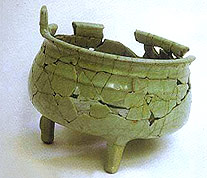
After the well-known tri-colored glazed pottery of the Tang Dynasty, the ceramic industry was to go on to enjoy a new heyday in the Song. There was an upsurge in both court and private porcelain kilns. The so-called ?Five Famous Kilns? of the Song -- Ru, Guan, Ge, Ding and Jun kilns -- became household names.
Digs at the Jun Kiln site in Yuzhou, Henan Province have revealed the story of this renowned court porcelain kiln from its early beginnings to its most prestigious days.
Since 1985 over 15,000 pieces of porcelain have been unearthed at the Ding Kiln site. It covers an area of more than 100 square meters near Jianci village, Quyang County, Hebei Province. The finds have added much to the body of knowledge on this ancient north China kiln.
Excavations in 2000 uncovered delicate chinaware at the Ru Kiln site in Baofeng County, Henan Province. This did much to help unravel its mysteries, as there are few accounts of this porcelain kiln in the historical record.
Extensive excavations have also been made at private kiln sites of the Song Dynasty. These have included the famous Longquan, Yaozhou, Jizhou and Cizhou kilns. For example ten kiln sites were excavated in Cixian County, Hebei Province in 1987. Among the results of these digs some 300,000 pieces of broken porcelain from the Cizhou Kiln came to light. These demonstrated that this particular kiln could be dated back to the beginning of the Northern Song Dynasty.
Dynasties founded by ancient nomadic peoples in China?s border regions such as the Liao, Xixia and Jin have all contributed their own artifacts to the archaeological record.
In 1999, archaeologists from the Ningxia Hui Autonomous Region, working in Helan Mountain found the foundations of 62 pagodas that had lain buried for hundreds of years. They were to unearth almost a hundred models of pagodas and statues of the Buddha. These artifacts are of great importance for they show the relationship between Tibetan Buddhism and the Xixia culture.
There have been many other significant finds. These have included relics of the Eastern Hu, Hun and Sienpi. These nomadic peoples lived in areas in present day northeast China and Inner Mongolia before the time of the Yuan Dynasty. Then there were the remains of military earth works of the Jin people in Heilongjiang Province.
Important cultural relics have been found from the regional Dali Kingdom, which was founded in 973. Centered on the city of that name in modern day Yunnan Province, it was to remain the political, economic and cultural center of southwest China for over 500 years.
An epitaph written in Khitan on a Jin tomb in Xinglong County, Hebei Province has given researchers valuable clues to the origins and structure of this ancient language.
It was in 1272 that Kublai Khan, the fifth emperor of the Mongol Empire and first emperor of the Yuan Dynasty, officially established his capital in Dadu, now known as Beijing. He was a grandson of Genghis Khan.
Based on many years? work at the Dadu site conducted by the Institute of Archaeology under the auspices of the Chinese Academy of Social Sciences, the overall layout of the ancient capital has been reconstructed.
In 1976 Archaeologists unearthed the remains of six wooden ships dating from the Yuan Dynasty. The finds were accompanied by bronze, ironware and pottery items together with 370 pieces of Cizhou porcelain which shed new light on the development of the Cizhou kiln in this later era of Mongolian rule.
In 2002 a Yuan Dynasty grave decorated with colorful murals was excavated in Zhuozhou city, Hebei Province. This find is of great importance to the study of fine-art history in China.
Then came the Ming Dynasty. Excavations of imperial mausoleums and extensive work on the Great Wall mark the archaeology of this period. Many precious funerary objects have been found in the Ding Mausoleum. The artifacts found in this Ming tomb of Emperor Zhu Yijun together with those of feudal rulers such as King Luhuang and King Liangzhuang reflect the economic and cultural development of the period.
In terms of the world-famous Ming Dynasty Great Wall, archaeological evidence has now shown that it started in the east from Jiangyantai Fort at the southern foot of Hushan Hill in Kuandian County, Liaoning Province. This overturns the previously held view that it started at Shanhaiguan Pass.
It has also been shown that the function of the Great Wall lay not just in military defense but also in protecting and regulating the trade routes.
(China.org.cn, translated by Shao Da, April 18, 2003)