Beijing?s citizens now enjoy better and faster public transport services and will hopefully be spared the inconvenience of traffic jams by 2008, according to the Mayor of Beijing, Liu Qi.
Reporter: Worried about traffic jams we left quite early this morning, but to our surprise traffic flowed smoothly and we arrived twenty minutes earlier than expected. How was the traffic for you today?
Liu: Very smooth too. It seems that there are fewer cars on the roads today.
Reporter: Is traffic easier for you, or do you sometimes encounter traffic jams?
Liu: I occasionally run into troubling traffic jams. In these instances, I will try to determine the cause, and arrange for the departments concerned to tackle the problem. For example, if the cause is poor city planning I will ask the traffic research center and relevant government departments to work together to find a solution. I have some statistics for you. Currently, 85 percent of Beijingers spend only one hour in traffic per excursion, 2.7 percent lower than several years ago.
Reporter: What does this mean?
Liu: In simple terms, people are spending less time getting from their points of departure to their destinations. For example, the President of Tsinghua University used to spend over an hour getting to my office for a meeting. Now it only takes him twenty or thirty minutes.
About five or six years ago there were 5,000 public buses, 350 routes and 6,000 km serviced by public transport. Now we have 13,000 buses, 700 routes and 12,000 km serviced by public transport.
Although traffic jams still exist in some areas, the above figures show that both the total area serviced and overall capacity have been greatly improved. Solving traffic jams has become a driving force behind Beijing city construction. Today Beijing citizens enjoy increasingly better transport services.
Reporter: It is said that the Beijing Municipal Government promises to settle 60 issues for its people every year and that six of this year issues relate directly to traffic.
Liu: This year?s 60 issues are all going according to plan with a number of them having been completed or resolved before the National Holiday. One of the most important issues relating to transport has been the opening of the western light railway system, which is regarded as a key aspect of the city construction project. As a matter of fact, we have two programs this year: one is transport, the other is environment.
Reporter: We now have less than six years left before the 2008 Olympic Games. Can you estimate what the traffic demands will be like by the time we reach this event?
Liu: If we have 300 km of subway by then, I think traffic in Beijing will have been fundamentally improved. With extensions of the No.1 subway line, the underground will reach as far as Tongzhou by the end of next year, bringing the total length of Beijing?s subway network to117 km, the longest in the country.
Reporter: Why are you so concerned with transport?
Liu: After studying transportation networks in major world cities similar to Beijing, we find that the biggest difference is not so much the width of roads, but rather the quality of public transport, especially subways. Paris has over 300 km of subway, as does Moscow and Tokyo, while Beijing has only a few dozen. One of the main lessons we have learnt from other big cities is that to solve traffic problems we must first develop a significant public transport network.
Reporter: What are the advantages of railway and subway networks?
Liu: First, they are very precise as they are not subjected to problems of traffic. Second, they are not influenced by climate changes. Third, they are safe. Fourth, they are environmentally friendly. Beijing is a rapidly developing city and it doesn?t have enough roads and rail networks. To protect the city?s heritage limit the number of roads being built, underground transport networks offer the best advantages.
Reporter: If Beijing wasn?t going to host the 2008 Olympic Games, would plans for the transportation network still be the same?
Liu: Even if Beijing wasn?t going to host the Olympic Games in 2008, traffic projects and carbon emission reduction projects would still be carried out. Only one subway line, No.5, will be directly connected to Olympic Games in 2008. So we haven?t based our transport plans solely on the needs of the 2008 Olympics.
Reporter: So, would we have the same timeline whether or not we were going to host the Olympic Games?
Liu: One reason the International Olympic Committee chose us was because they found our plans were not just aimed at the Olympics.
Reporter: The development of Beijing?s rail networks will require over 40 billion yuan (US$4.83 billion) in investment. Where will this come from?
Liu: The government will lead the way and encourage society as a whole to participate.
Reporter: How much will the government invest?
Liu: Generally speaking, government investment will not exceed 20 percent of the total, less than 8 billion yuan (US$0.96 billion) . Yet government investment is absolutely necessary to attract money from other circles and help make investors feel more confident.
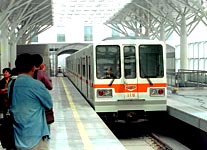
Reporter: The 20 km long western line of Beijing?s light rail network was officially opened on September 28. It now takes only 20 minutes to get from Xizhimen to Hui Long Guan. You were among the first passengers that day, how did that make you feel?
Liu: It was very pleasant. However, I must point out that the current trains are actually old restored trains, because the new ones are still in the factory. The new trains will be installed in a few months from now. They will be much more comfortable.
(The newly opened city railway is so far the longest transport line in the nation. It starts from Xizhimen and heads north through the third ring, fourth ring and fifth ring, crossing Zhong Guancun, Peking University and Tsinghua University. After 6.5 billion yuan (US$0.78 billion)in investment, it has reached a total length of 40.85 km. The eastern line will open at the beginning of next year.)
Reporter: It seems that the percentage of buses being used for public traffic has been declining for the past several years, what?s the reason behind this?
Liu: The reason is the rapid rise in private car ownership. There are now over 1. 8 million motor vehicles, a number which is increasing at a rate of 10 percent per year. So we face the choice of either stopping this trend or finding alternative transport methods. Obviously, we have chosen the latter option.
Reporter: You are also encouraging the car industry. It is said that you want to make it one of Beijing?s pillar industries. Aren't you concerned there might be too many cars on the road?
Liu: Looking at the experiences of other big cities in the world, 3 million cars and 300 km subway are enough to accommodate the population. Actually, Moscow has 3 million cars and Tokyo has 4 million, so the number of cars doesn?t really make that much difference. The main point is to develop the public transport system. We can?t blame private car ownership for public transport problems. On the contrary, it is backward public transport systems that force citizens to buy their own cars.
Reporter: In your opinion, how many citizens should the public transport facilities cater for? For example, 87 percent of people in Tokyo choose public transport for daily commutation; at least 65 percent of people in Paris, London and New York do the same. What then is Beijing?s target?
Liu: We plan to encourage 60 percent of citizens to choose public transport while 20 percent will continue to rely on bikes. Since bikes have already become a characteristic of Beijing, we don?t need to concentrate on only rail transport, as in the West. Bikes plus public transport will account for 80 percent of citizens while the remaining 20 percent will drive private cars.
(After 2008, Beijing will no longer be tormented by traffic congestion. People will have more transport choices including buses, subways, light rail, bikes and cars. You will be able to find a subway station within a five minute walk from anywhere in the downtown area. Excursions on public transport will take less than 40 minutes. If you want to go to the Olympics in 2008, Mayor Liu recommends you take either the bus or train.)
(china.org.cn by Zheng Guihong November 1, 2002)