Under the initiation of the UN Millennium Summit, the UN Secretary General Kofi Annan announced the establishment of the UN Information and Communication Technology Task Force in November 2001 with the aim of bridging the digital divide. In June 2002, the 56th UN General Assembly convened a special meeting to discuss the issue of bridging the digital divide. In this meeting, it was decided to hold a world summit in 2003 to further appeal energetically on a higher level for the effective action to bridge the digital divide. It has become the shared understanding of all the countries that the efforts UN has been making to promote the balanced development of the information community by bridging the digital divide are as important and profound as the sustainable development strategy, which can be compared with the 2002 Environment and Development Meeting.
Since the 1980s, all the countries, especially the developed countries, have developed information technology with full efforts, which has largely promoted their economic growth. The development, spread and application of the information industry, especially the wide use of Internet in the past decade, has not only given impetus to the development of the information industry, but also cheered up the traditional industries like manufacturing and service industries with new competitive energy. At present, there truly appears a quite optimistic and exciting prospect in the process of building e-Community of the developed countries and some developing countries. E-Government has raised the work efficiency of the governments; e-Business has shortened the gap between enterprises and clients and among enterprises, increased the enterprise?s efficiency and also promoted its quick reaction ability in the market; the finance informatization has not only offered great convenience to users, but greatly fastened the fund circulation as well; the development of broad-band communications and satellite communication technologies have made telemedicine and distant learning possible. Under the promotion of IT, e-Community is changing human?s working and living ways.
Therefore, it was considered that the application of IT would help the developing countries and backward regions obtain a big-leap forward, if IT could really narrow the gap between the backward regions and the outside world, if the Internet could really make everyone have an equal chance of obtaining the information and knowledge, if telemedicine and distant education could really provide the backward regions with the opportunity of rapid, cheap first-rate service and high quality education, and if?
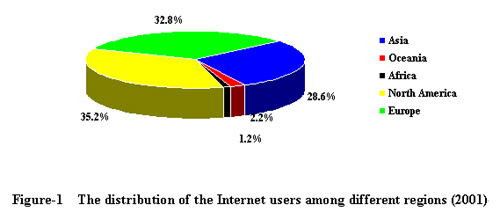
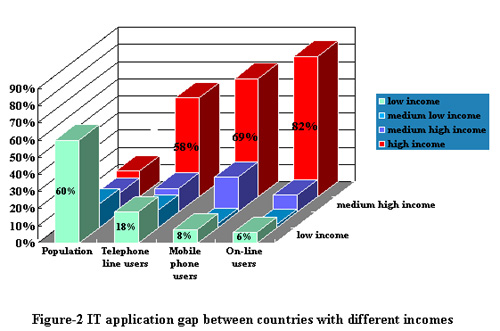
However, while IT has brought huge economic profits and social progress to the developed countries, recent fact has shown that the gap is being rapidly enlarged on the IT application between the developed countries and a large number of developing countries. This gap is called the Digital divide, which is even much wider than that between the rich and the poor of the world. The per capita GDP of the high-income countries (covering about 18 percent of the global population) is as 100 times as that of the lowest-income countries (covering about 20 percent of the global population), and according to the measure of informatization index (such as per capita ownership of computer, per capita on-line use), the former is over 500 times higher than the latter. At present, the quantity of computers the USA processes has reached the total number of the other countries in the world; 95 percent of Internet users in the world are from less than 5 percent of the world population; in the city of New York alone, the number of network host computers is more than the total of Latin America and the Caribbean, and that of one country, Finland, also surpasses the total of the African Continent. Figure-1 shows the distribution of Internet users from different regions in the world and Figure-2 demonstrates the IT application gap between different countries based on their income levels.
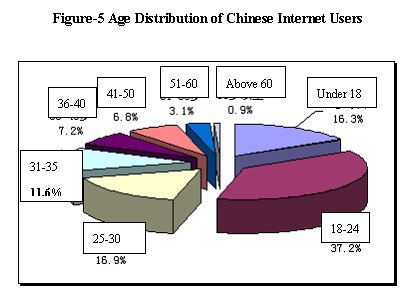
The digital divide exists not only among different countries, but among different regions of a country, between cities and rural areas, and among people of different age as well (for example, more than 85 percent Internet users in China are youngsters below 35). Considering the increasing role played by informatization in promoting social development, the world opinion generally believes that the huge digital divide or wide informatization gap will further expand the gap between the rich and the poor. That means that all the efforts the whole world has made in recent years would be vanished. In such a society with growing keen competition, it has become an issue of the rights for development and survival to have the chance of obtaining information, in addition to that of democratic rights.
The formation of the digital divide has its in-depth social and economic background. In addition to the gap between the rich and the poor and the difference of education, other important reasons for the widening the digital divide include the core technologies in the field of IT, which are mainly controlled by a small number of developed countries and multinational corporations, and the double barriers of technology and price. Many developing countries are worried about the situation that the monopolization of the information technology by a few multinational corporations is increasingly widening the digital divide, which makes their position marginalizing in the global social and economic development. The widening of the digital divide resulted in the larger gap and the disparity between the rich and the poor, which seriously threatens the stability and security of developing countries and the whole human society. Numerous developing countries intensively appeal to the UN for its leverage to help them master and use IT, so as to bridge the digital divide. Also, some insightful people from developed countries feel the threat to the global security and stability brought by such a disparity while some large enterprises have predicted there would be more market opportunity through the action of bridging the digital divide. All above have formed objectively a win-win prospect of the enterprises and the public service. As a result, the initiative of IT for development and bridging the digital divide has won a wide response from all the countries and all social circles.
I. The Present Overview of the World Digital Divide
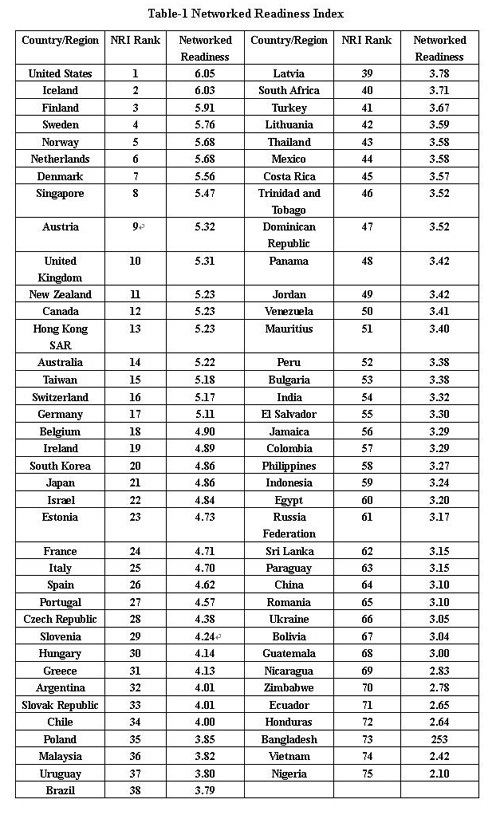
Searching in the world Internet, we can easily find a great number of special websites and articles regarding the digital divide. Many international organizations such as World Bank and its subordinate infoDev, UNDP, UNESCO, OECD and so on have all organized large-scaled surveys and discussions regarding the digital divide in recent years. This year, the World Economy Forum published ?The Global Information Technology Report 2001-2002?[1]. This report delivered 65 quantifiable variable statistics focusing on 75 main countries or regions in the world, and a comprehensive index -- Networked Readiness Index, the result of the weighted average of those data. Among those 65 variables, 20 are called Hard Variable with directly quantifiable data, 45 Soft Variables with quantifiable data after sample investigation by questionnaire. These variables include not only the present statistical data on the application of information and communication technology of different countries, but also an potential index accessing to informatization society, which is measured on the basis of the economic growth, education, government?s attention, and the information infrastructures situation of an country. Though there exists a few indexes with certain prejudice, the report is really the most comprehensive and complete statistical report measuring the informatization of all countries so far. In this report, there forms a line according to the above variables or indexes for the world?s 75 main countries and regions, including HKSAR and Taiwan, representing 80 percent of the world population and 90 percent of the total output. Table-1 is the informatization index from the weighted average of 65 variables standardizing from 1 to 7 and the line of 75 countries and regions. (To the statistics of total data and line, please go to [1])
Though there still exists many problems for discussion, like whether the choosing of those 65 variables is suitable, whether those variables fully display the characteristics and the prior developing orientation of the developing countries, whether the part of investigation by questionnaire reflects the situation of countries comprehensively and objectively, etc., these statistics have at least led us to the following conclusions::
1. Developed countries are totally far ahead of developing countries on all the indexes. In some hard variables, such as Internet users per hundred people and mobile phone owners per hundred people, the highest country reach several hundred and even several thousand times more than the lowest one.
2. Some newly industrialized countries and regions have an outstanding performance in the field of informatization and are striding ahead. For example, Singapore, Hong Kong (China), Taiwan (China) and South Korea rank respectively at the 8th, 13th, 15th and 20th, which surpass Germany (17th), Japan (21st), France (24th) and Italy (25th). Some developing countries also perform well, such as Czech (28th) and Brazil (38th). Among the developing countries in Asia, Malaysia (36th) and Thailand (43rd) are relatively prior.
3. Because the populations of different countries vary greatly, and many indexes are measured with per capita, it may be easier for some small developing countries to get a relatively greater growth on informatization index in a short term. By comparing China with India, the Chinese people can get a clear idea of China?s overall level of informatization. Though India?s per capita GDP is only half of that of China, owing to its focus on information technology in recent years, its e-Community has expanded rapidly. In general rank, India (54th) is ahead of China (64th). Owing to the great efforts China has made in developing infrastructures in recent years, people?s living standard is rising fast and the government is also attaching importance to information technology, which makes China surpass India in some sub-indexes as follows: per capita fixed telephones (China 54th to India 69th), per capita mobile phones (China 56th to India 73rd), spread speed of mobile phones (China 24th to India 72nd), waiting time of phone installation (China 27th to India 42nd), per capita Internet users (China 60th to India 73rd), per capita computers (China 60th to India 73rd), Internet fee index (price/per capita GDP) (China 51st to India 63rd), working efficiency of governments (China 46th to India 56th), waiting time needed for the registration of opening corporation (China 19th to India 70th), women?s attendance in the economy life (China 39th to India 46th), the popularity of Internet in school (China 39th to India 46th) and the popular education of the whole people (China 54th to India 65th); while in some other indexes China is behind India: the strength of eliminating software piracy (India 42nd to China 66th), professional IT services (India 11th to China 51st), the suitability between national and international software products in one?s own country (India 26th to China 66th), the competitive power of national software corporations on the domestic market (India 4th to China 50th), the competitive degree of national communication corporations in assuring their service quality (India 41st to China 57th), the framework of laws to support the development of IT corporations (India 24th to China 45th), the input of staff?s IT training (India 34th to China 61st), the quality of IT training and education (India 9th to China 63rd), B2C e-Business (India 38th to China 49th), B2B e-Business (India 40th to China 55th), national risk capital input to e-Business (India 12th to China 39th) and government?s on-line service (India 32nd to China 40th). From above, it is obvious that in some indexes of IT such as professional IT services and IT training, India is even ahead of some developed countries. India has also built up a quite solid base and has potential in some aspects of IT application such as e-Government and e-Business. Furthermore, what should be especially mentioned is that both of the two governments highly stress informatization, making them both rank the 13th.
II. China?s Informatization Development and Digital Divide
Great achievements have been gained in China?s information construction in recent years. The effect of informatization on national economy and social life is gradually increasing while IT industry including its relating industries has achieved a growing proportion and gained a noticeable position in national economy. The ratio of added IT value in GDP was raised from 2.45 percent in 1993 to 4.66 percent in 1998, while the contribution rate of the newly added value to the year?s added GDP from 4.22 percent in 1993 to 11.00 percent in 1998. In the year of 1999, the contribution rate of China?s IT industry reached over 10 percent, which was one percentage point of the 7 percent GDP growth rate. And, the export value of IT products reached one fifth of the total export value of China. In the recent decade, the annual speed increase of IT industry is over 32 percent, which is nearly 18 percentage point higher than that of the whole industries of the corresponding period. The application of information technology, such as the appearance of gold tax, gold custom and gold card remarks the large-scaled use of China?s information technology; the application of enterprise information technology such as CAD and CIMS has made great progress; e-Government, e-Business, distance education and telemedicine have further advanced. In 2002, China?s e-Business trade volume would be up to 800 million yuan RMB, and with such an astonishing speed, it is predicted to reach 20 billion yuan RMB.
Owing to the rapid growth of China?s information infrastructure since the 1990s, there are all kinds of ways for communication, such as optical fiber, digital microwave, satellite, programme-controlled exchange, mobile communications, data and multimedia, covering throughout the city and countryside and linking China with all over the world. In recent two decades, China?s total phone users have been raised from 2.03 million in 1979 to 375 million in 2002. The scales of the fixed and mobile networks both ranked 2nd of the world. The national phone popularity rate reaches 30.2 per hundred people, among which, the fixed popularity rate 15.65 lines per hundred people and the mobile phone 13.86 sets per hundred people. (Data resource is from National Communication Industry Development of the first half of 2002 of Ministry of Information Industry.) The Internet users are over 45.8 million, 74 times more than that of 1997. China?s total bandwidth of internet international line has reached 10576.5M, 416 times wider than that of 1997 (See The 10th China?s Internet Statistics Report from CNNIC in July 2002).
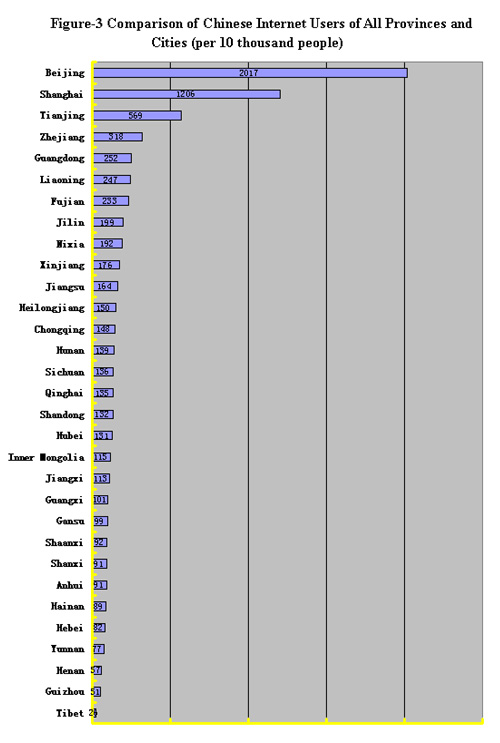
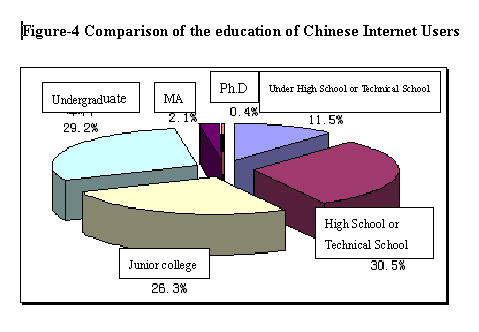
While seeing the great achievements of our informatization construction, it should not be ignored that our development is still far behind the step of the world IT and its application development. There exists an extremely unbalanced development of China?s informatization especially the information gap between different regions, city and countryside, and different ethnic groups. Take 100 as the average of the whole, the Internet popularity rate of the East, the Middle and the West is 197:45:32, the per capita telecommunication service 182:71:49, the phone users are respectively 195 million, 110 million and 70 million, holding a percentage of 52 percent, 29.3 percent and 18.7 percent respectively. There is considerable and enlarging disparity in information for city and countryside. The city penetration rate in 1990 was 1.78 percent while that of the countryside was 0.17 percent, the former being only 1.61 percentage points higher than the latter. But by 1998, the former was up to 19.19 percent while the latter was only 3.92 percent, the former was 15.27 percentage points higher, a gap obviously wider than that in people?s income. At present, there is only 0.3 percent of network users are farmers, that is to say, the city popularity rate is 740 times of that of the countryside. Majority rural population especially those in the Middle and West regions is marginalized in the revolutions of information and network, which caused a new situation of poor-knowledge and poor-information population in this new century. That will largely threaten agriculture modernization and rural industry structure readjustment. The following figure displays the regional, educational and age difference of China?s Internet users, whose data comes from The 10th China?s Internet Statistics Report written by the State Statistics Bureau and the CNNIC in July 2002.
III. Bridging the Digital Divide and Promoting Social Sustainable and Balanced Development
Facts indicate that despite the governments have made major efforts to bridge the digital divide and the informatization steps of some newly rising developing countries and regions are quickening, these changes are still far behind the trend of enlarging digital divide. If we can say that the poverty of many regions just demonstrates the present situation, whether the digital divide could be bridged effectively and rapidly will decide the prospect of the future several decades and the sustainable development of the whole society.
Like sustainable development strategy, bridging the digital divide is also a comprehensive programme relating all aspects of the society and a hard long-term objective for China?s social development. It needs an overall support and attendance from all the social community.
1. Strengthening the coordination among government departments making governments at all levels play a energetic leading and supporting role in the process of bridging the digital divide
In 2003, the United Nations will convene a Special World Summit to discuss the issue of bridging the digital divide, hoping that leaders throughout the world especially of the developing countries would attach full importance to the seriousness and urgency of this issue. China should study its present digital divide situation and make a macro plan for bridging the digital divide. All local governments, especially the leaders, should raise their attention on bridging the digital divide, make a plan for action, expand the budget to support the local informatization construction, and attract enterprises, scientific research institutes, schools and intermediate agencies to participate in the action of bridging the digital divide. Leaders, especially those in the Middle and West regions, should go through trainings so as to promote social progress and informatization through e-Government, distant education and so on.
2. Maximizing the role of enterprises in bridging the digital divide
Enterprises are going to play an important role in bridging the digital divide and more foreseeing entrepreneurs should take part in actions right now. Many large IT enterprises have joined the international organizations in major activities aiming at bridging the digital divide. Leaders of those enterprises all take it as a glorious public service, which can also create huge market for IT products. It will lead to win-win results for both the enterprises and the people. Many Chinese IT enterprises haven?t yet realized there is a big market in the Middle and West regions and the country?s rural areas, where information service and products as well as contents suitable to those regions are badly needed.
3. Energetically popularizing ICT basic knowledge education
Popular education is the important base of bridging the digital divide. It is required to popularize the computer teaching in middle and primary schools, list ICT basic knowledge courses as required ones for basic education of middle and primary schools. By doing so, the new generation will have the basic knowledge about computer and its operation skills and will not become digital illiterate in the time of informatization. It is also required to combine this action with other programs of aiding the poor areas such as Hope Project, Chinese Volunteers Action and that of doctorate teams going to the Countryside to help with teaching problems.
In areas short of talented personnel, it is required to energetically train the existing teachers and make full use of the information and communication base of rural middle schools and major village primary schools to conduct a massive training course for students and teachers on IT basic knowledge and relevanted skills to farmers in the surrounding areas. Furthermore, modern IT tools like satellite and radio accesses should also be fully used to provide wide training on basic computer skills and the distant education in rural areas and remote regions.
4. Developing information resource and realizing the information sharing
Information resource is the core of informatization. Even the best information network cannot work without information resource. Our present information resource supply is far beyond satisfying social demand of information, but a large quantity of non-networked information resource is harmful to information sharing. Based on this situation, it is required that the information content should benefit the users in raising their economic income and living standard with the basic principle of ?benefiting the users?, making the public become aware of the benefits of using the modern information and communication technology.
To develop information resource and realize information sharing, the first step is to develop the information resource from governments and to promote the e-Government. Our government departments and the subordinate public agencies have accumulated a large amount of public information, most of which is not open to the outsiders. On-line project of e-Government should be a pivot in promoting public information sharing in a large range. It should establish professional informant in all departments and public agencies should be responsible for the on-line information sharing. Public information shared on-line should be in accordance with the law.
Large amount of useful information from universities and polytechnics and research institutes should be on line. The agricultural information network and national business supply and demand information network should be energetically extended and constructed, so as to benefit everyone at every level of the network.
5. Building market competitive environment and strengthening information infrastructure construction
There should be further emancipation of mind to realize the different operation modes of ownership for telecommunication suppliers and promote the formulated and sound development of the market competitive environment. It is needed to further lower the telephone initial installation fees, telephone-using costs and network-using fees, strengthen government support for telecommunication infrastructures in the Middle and West regions and the rural areas and raise the popularity rate of phone in backward areas, gradually realizing the community network popularity in the Middle and West regions and the broad rural areas. The stepping up the building of e-Government, e-Business and relative laws and regulations will help guarantee the connectivity access to public service institutions, such as governments from the Middle and West regions, agricultural scientific popularity stations, saving banks and post and telecommunication offices. The development of broadband should be strengthened with major efforts in large and medium-sized cities and small cities or towns with certain conditions, so that users can have high-speed access to the network for information from units or communities such as the local governments, public sectors, schools and private sectors.
6. Developing ICT products especially for poor areas
Having controlled the core technology in the fields of information and communication, the developed countries and big multinational corporations are firmly holding the actual right to formulate the relating standards and regulations, while having really seized the initiative of ICT development with the backing of strong priority of economy and talented people. On the contrary, owing to low development, backward technology and shortage of talented people, the developing countries are usually in a passive and disadvantage position in the course of economic globalization. Therefore, the developing countries should greatly develop cheap and convenient information products tallying with their own economic acceptance ability based on their specific development situation.
7. Actively developing international cooperation under the framework of the United Nations
In November 2001, UN ICT Task Force was established by the UN Secretary-General Kofi Annan with the intention to bridge the digital divide according to the related resolution of ECOSOC and the spirit of Millennium Declaration. The ICT Task Force aims to integrate and coordinate the work under the framework of the United Nations and to establish cooperative partnership with the UN system, governments of member countries, private sectors, financing organizations, fund donators and project participation countries. The ICT Task Force also focuses on spreading IT services all over the world through arousing global power to bridge the digital divide and offer digital opportunities for developing countries. The Task Force, with over 30 members representing developed and developing countries, business circles and NGOs, has made short-term and medium-term plan regarding the following six aspects: government participation, international ICT policy-making, human resource development, low-cost technology, products research and global resource mobilization. [2] Furthermore, it has made a decision to set up five regional network centres in Asia, Latin America and the Caribbean, East Europe, the Arab states and Africa, which will be in charge of coordinating the united action of bridging the digital divide in respective regions.
As the representative of China, I joined UN ICT Task Force and together with other Asian countries, attended the Inauguration of UN ICT Task Force Asia Regional Network as the implementation of the UN resolutions in June 2002 in Shanghai. Participants of this meeting included senior officials from central and local government officers of Asia countries, entrepreneurs, scholars and representatives of international organizations from over 10 Asian countries and Pacific Island countries such as Japan, Mongolia, Singapore, Indonesia, Malaysia, Philippines, Vietnam, Cambodia, India, Pakistan, Bangladesh, Nepal, Sri Lanka and Fiji. UN ICT Task Force Asia Regional Network was formally launched at this meeting, and the website www.unict-asia.org was also opened to the public. Following is the structure and the main framework of the Asia Regional Network the meeting had initially identified:
1.All stakeholders in Asia, such as governments, private sectors, international organizations, academia, civil societies and NGOs are invited to be the member of the regional network;
2.The Asia Regional Network will offer services to Asian countries for their programme of ?ICT for development?. It will organize High-level Regional Policy Forum, assist Asian countries identify their strategy and priority on ICT for Development and coordinate the cooperation on the issues among all countries; it will establish a new cooperative partnership among all stakeholders; it will help Asian countries enhance their ability building, develop human resource and entrepreneurship; it will promote the sharing of knowledge, information and data, advancing ICT transition and protection of intellectual property rights; it will also develop case study and spread the best pattern of development to improve the link of Internet and to lower its cost, and, research how to make use of ICT for poverty eradication. The network will achieve the above objectives through all kinds of substantial cooperation projects.;
3.The Asia Regional Network will establish a Steering Committee. Members include the stakeholders of officials from governments of Asia countries, well-known entrepreneurs, senior experts, international organizations, civil societies and NGOs.
4.The Asia Regional Network will be jointly coordinated by China, India and ESCAP. China will be responsible for the coordination with the governments; India will be in charge of the liaison with the private sector and scientific research institutions; and ESCAP will play a role in coordinating with relevant international organizations.
5.The Asia Regional Network will depend on the Regional Cooperation
Office for City Informatization as its Secretariat, which is responsible to run the website and coordinate and organize the cooperation projects.
The establishment of the Asia Regional Network is of positive significance for further promoting the policy dialogue, technology exchange and human training on relative aspects in Asia of UN ICT TF. Meanwhile, the establishment of UN ICT TF Secretariat in Shanghai will play an active role for China?s full use of national and international resources through UN ICT TF in strengthening the international cooperation and exchange on ICT, introducing and learning from the advanced technology and experience of developed countries.
The action of bridging the digital divide initiated and being organized by the United Sates will play a positive role in arousing and organizing all governments, entrepreneurs and NGOs the world over to get committed to the task of bridging the digital divide and in accelerating the process of social informatization for developing countries. As a whole, China should get itself totally devoted to the action of bridging the digital divide under the framework of the United Nations.
Notes:
[1] Geoffrey S. Kirkman, Peter K. Cornelius, Jeffrey D. Sachs, Klaus Schwab, The Global Information Technology Report 2001-2002: Readiness for the Networked World, New York, Oxford, Oxford University Press, 2002
[2] UN ICT Task Force Plan of Action, see UN ICT Task Force website:http://www.unicttaskforce.org
(china.org.cn August 7, 2002)