|
|
|
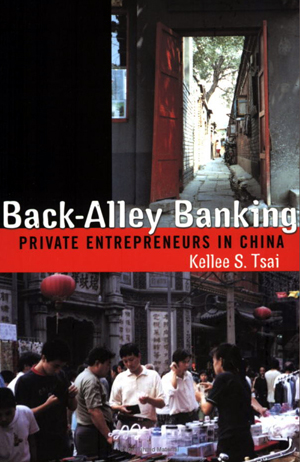
Bank-Alley Banking
Private Entrepreneurs in China
By Kellee Tsai
Cornell University Press, 2004;
ISBN: 978-0-8014-8917-4 |
Reviewed by Valerie Sartor
Since the reform and opening up that began in 1978 in China, over 30 million private businesses have appeared and they are helping China's booming economy. Yet many of these private business ventures have no access to official sources of credit. China's state banks cater to state-owned enterprises?-- private financing still officially remains illegal. Chinese entrepreneurs are forced to fund their capitalist dreams by defying national banking laws. They use many ways to acquire financing for venture capital and loans. Rotating credit associations and private banks disguised as other types of organizations are two ways money passes into private businesses.
Kellee Tsai is an Associate Professor of Political Science at Johns Hopkins University in the US. Her book Back-Alley Banking: Private Entrepreneurs in China uses her research into China's unknown banking systems to explain how small private businesses acquired their funding. Her thesis is that local social groups and political connections have helped creative small-scale entrepreneurs to get needed monies and to secure various private property rights. In China industrious businessmen and politicians both have capitalized upon the vague and amorphous government regulations to get rich.
The book highlights and entertains by recounting the relationship between China's evolving politics and economy. In some cases private businessmen, helped by local bureaucrats, have gleaned some of the credit designated for state owned enterprises. Other bureaucrats are ignoring their jobs as government guardians and choosing to invest their time, connections and own money into private ventures.
Tsai's book, a combination of sociology and economics, provides extensive fieldwork, narratives and stories, merges her research with previous findings. It's wonderful reading, not your usual tedious academic writing, and it's very helpful to foreigners doing business in China.
Tsai must have come up with her book's title by discovering that many types of private finance in China were hidden and as convoluted as a Chinese hutong. This is because financing outside of a state bank, such as the People's Bank of China, is officially illegal?-- yet the finance agency might be registered with another official governmental agency. Despite this seemingly valid registration status, the operations remain incognito "just in case" of any sort of official crackdown. So Professor Tsai stopped looking in legal channels and started looking down China's back alleys.
Tsai defines informal finance as all types of financial exchanges that are not officially sanctioned by China's banking system. This ranges from money lending (interest-free or otherwise) between friends and relatives and shopkeepers, to informal business lending with interest rates, some of which may be higher than legally allowed. Other financing arrangements included rotating credit associations and private money houses. This can represent many kinds of enterprises because only Minsheng Bank, China's first joint-stock bank owned by non-public enterprises, acted as a legal lender in China up to 2004, when Tsai published her book.
And in fact all across China many types of creative financing have appeared. Each varies from province to province and even from county to county. Every local government exerts influence on the lending apparatus and Tsai defines them into four main categories.
The first category developed in China's poor, mountainous regions. These areas have little informal financing; people with incentive have left the region.
The second type of informal finance concerns areas that didn't receive much financial support from the central government under Mao. Tsai cities the coastal south: capital and funding was denied there because Mao thought that foreigners considered the area a likely point of entry in case of war, and because geographically this region is near Taiwan and Hong Kong. Yet Guangdong, Fujian and Zhejiang ended their communal system before the government officially sanctioned it. Zhejiang is famous for the small-scale private sector that boomed even before Deng Xiaoping announced reforms. Early on this southern coastal region bent the rules regarding informal finance. A variety of informal financing mechanisms currently exists; some are highly successful and competitive.
Tsai cites Wenzhou as the most famous place in the south. During the mid-1980s, up to 95 percent of all financial flows didn't go through state banks. Locals withdrew their money from state banks to earn interest from the informal banks, causing the state banks to have to float their interest rates. Up to 2003 some black market operations charged interest by the hour and were open 24/7, according to Tsai. Even more interesting, little communities of Wenzhou have sprung up around the world because the people there are so well connected to each other.
The Chinese call the third kind of illegal banking system the "Sunan model". The word refers to those parts of China where strong brigade and collectivist institutions were built during the Maoist years when the local government greatly influenced the local economy. During the reform and opening up these places gave birth to healthy township and village enterprises and fueled rural industrialization. Sunan model regions are known for close relationships between local businesses and the local governments. Until the 1990s collective enterprises turned to the state banking system but the private sector depended on informal financing systems. In the 90s collectives began undergoing privatization. Significantly, often the same township and village enterprise managers and bosses became private individual owners of these newly privatized firms. With their excellent connections (guan xi) they still had great connections to the state bank and received special treatment. Meanwhile, the truly original private firms had to depend on their own informal financing, as usual.
The fourth and final developmental type consists of regions that received great funding during Mao's era. These privileged places had massive factories, many employing from 50,000 to 80,000 workers. Under the planned economic system they thrived. Later, with the reforms, they are floundering due to competing developmental priorities. The government feels obligated to subsidize and assist state-owned enterprises because they employed so many people and without steady jobs social unrest is highly likely. Yet those employed by the local governments are also being pressured to create more wealth so they support and tolerate new kinds of local economic activity in their areas. Businessmen in these areas must be very careful and very discreet as well as very creative because relationships and politics are so closely intertwined.
Tsai points out that local politics and the local economy has created many different patterns for creative financing. She cites a reading club that acted as a front for an informal stock market as a case in point: someone with an advantaged position used it to discreetly garner wealth for a small group of friends/investors. The magazine reading club owner happened to be a former manager of the People's Bank of China who got bored with his desk job and wanted to make more money. With his local government contacts he easily registered his club and with his experience and network he quickly created a way to trade futures. Members actually called their profits "reading bonuses". In China this is one of many examples where a person with excellent guanxi and some know-how innovates and starts up a private business.
By the late 1990s the private sector in China had grown to contribute an estimated one-third of GDP and most had no access to formal credit. Tsai asserts that because the most dynamic part of China's economy didn't get any formal bank credit they are in fact responsible for China's apparent economic miracle in private sector development.
Whether private sector development can be successful in the long run without access to formal credit over time is still unknown. Tsai and other experts feel that China needs more regularized access to formal sources of credit.
Tsai also points out that, beginning in 2001, after China has signed up to under the WTO, the financial system did become slightly more liberal. But the changes are small and long in coming. Most people in power recognize that the road to the future lies in different financial patterns but politically these same leaders must be sure that they aren't treading on anyone important in the government hierarchy.
Perhaps Chinese leaders have reason to feel uneasy. Traditionally, China, as a socialist state, possesses an inherent legal monopoly concerning the distribution of capital. Free capital markets in China don't legally exist, or didn't exist, until Deng Xiaoping started the reform and opening up. Once the economic ball got rolling it has become harder and harder to control because China has no laws or infrastructure firmly set up. Government leaders are creating as they experience challenges and intrusions on their power base.
When informal financiers start setting up shop and moving money around this is perceived as a violation to the state. Another problem is the rampant corruption that all financial markets – private or state – run the risk of getting mired in if they have no regulatory agencies monitoring them. When they're not properly regulated they run the risk becoming corrupt. Finally, who is accountable in private financial markets if they fail? Tsai states that a number of cases involving failed investment schemes, failed financial companies, etc., created local social and political instability. Angry, ordinary people blamed the government for their losses and wanted their socialist government to compensate them – even though they had invested in failed schemes using private capitalist networks.
Regarding China's future development, Tsai believes that the concept of the developmental state should be viewed as a rather descriptive term. It belongs to those countries that developed quickly and all had well-defined and well-disciplined bureaucracies. It does not fit all the Asian Tigers. China can't be considered or compared to a developmental state: as a country it stands alone and has been groundbreaking in terms of the kinds of problems it has encountered. Chinese businessmen have created several hybrid ownership schemes that are meant to cope with the vast diversity in terms of the speed with which it's reforming various parts of the economy. China really stands as a unique economic model and any foreign businessman coming here should take note of that.
(China.org.cn July 22, 2008)