1. The Gexinqiao relics of the Neolithic Age in Guangxi
Zhuang Autonomous Region
The Gexinqiao relics of the Neolithic Age, as the only discovery
that shed light on the pre-Qin period in the top ten archeology
discoveries, came from an historical site in Baise, south China's
Guangxi Zhuang Autonomous Region. The site was believed to be a
"factory" during the New Stone Age, where early humans produced
stone implements.
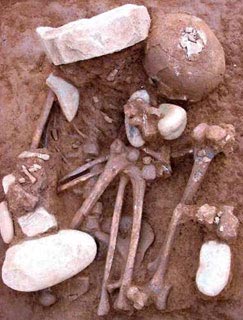
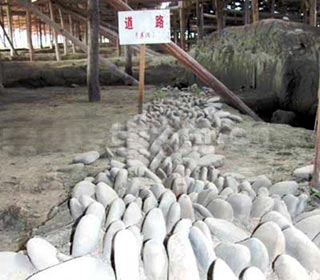
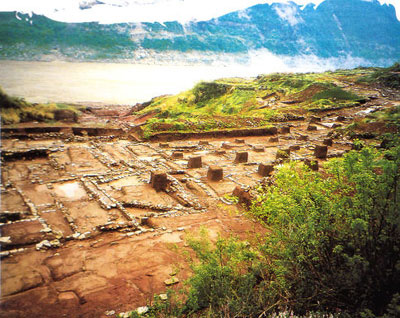
Scattered at the site are large stones with flat surfaces, which
primitive man leaned on and used as chopping blocks. Around the
stones were found stone hammers, hatchets and other implements.
The “factory”, which remained intact for more than 10,000 years,
surpasses other finds from primitive society in China because of
its large size and quantity of artifacts.
2. Bamboo slips of official documents of the Qin Dynasty
(221-207 BC), Liye City, Hunan Province
In a well, researchers found, unexpectedly, 36,000 wood and
bamboo slips on which more than 200,000 characters were written
clearly with brushes, in the ancient lishu (official script)
style. The items were found during excavations on the remains of an
ancient city which prospered in the Qin Dynasty, in the obscure
county of Liye, central China's Hunan Province.
The characters on the slips provide an encyclopedic record of
the dynasty's political, military and economic situation.
They also shed light on the ethnic groups, laws, cultures, postal
services, geography and government hierarchies of the period.
The well find contained 20 times the number of slips bearing Qin
Dynasty records than previous discoveries.
The slips escaped the dynasty's early cultural purge because
they were official documents instead of "alien" philosophies. They
were believed to have been thrown into the well in the war that
ended the dynasty.
3. Haiqu ancient tomb of the Han Dynasty (206 BC-AD 220) in
Rizhao City, Shandong Province
More than 90 tombs were found in the Haiqu ancient tombs of the Han
Dynasty (206 BC-AD 220) in Rizhao, east China's Shandong Province.
Most of them were double coffins or triple coffins or even more.
The coffins are all exquisite in black lacquer.
?
More than 1,200 elaborate lacquer artifacts were excavated,
along with pottery, copper ware, wood ware, jade ware, iron ware
and horn work in which there were more than 500 lacquered artifacts
and quantities of silk fabric unearthed in the tomb. These
discoveries were not only in great quantity, but also the
best-preserved examples of the Han Dynasty in Shandong Province,
providing very important information in the study of the lacquer
and textile artifact industry in the Han Dynasty.
These tombs also provide more information on the study of
funerary conventions of the Han Dynasty.
4. Ancient tower relics of the period between Eastern Wei
(534-550) and Northern Qi (550-577) in Yenan City in Hebei
Province
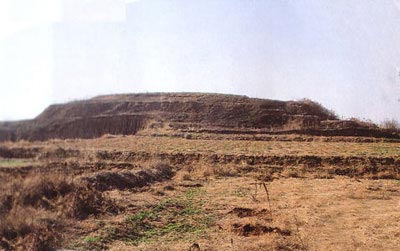
The remains of a wooden pagoda in north China's Hebei Province
dates back to the Northern Dynasties (AD 386-581).
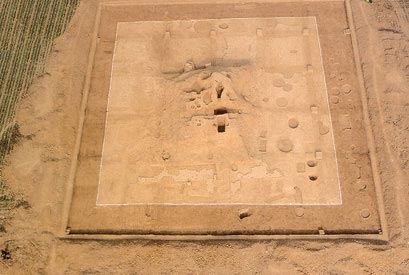
The ancient tower relics are the remains of a square wooden pagoda
in Yenan City, north China's Hebei Province, which dates back to
the period between Eastern Wei (AD 534-550) and Northern Qi (AD
550-577). Each side is 45 meters long and the pagoda’s foundation
is especially solid -- six meters deep and alternated with 10
layers of pebbles and earth.
Abundant building components were unearthed, such as tiles,
column footstones and carved stone and many colored Buddha patterns
and relics were excavated, reflecting the scale of the pagoda.
The pagoda was in a magnificent scale and was the only Buddhist
wooden square pagoda relic found between the Eastern Wei (AD
534-550) and Northern Qi (AD 550-577). A few finds filled in the
gaps in archeological knowledge between the Han to Tang dynasties.
The pagoda is significant for the study of the Northern Dynasty
Buddha temple structures and also for the Buddhist pagoda
footstones.
5. Ancient tomb of Xu Xianxiu in Northern Qi (550-577)
in Taiyuan City in Shanxi Province
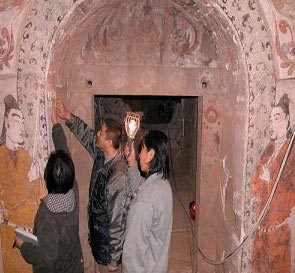
After months of hard work, Chang Yimin and his colleagues from
Shanxi Provincial Institute of Cultural Relics and Archaeology
managed to open a giant stone gate, decorated with bas-relief of
unfamiliar animals and birds, in July 2002. Upon discovery, they
were overwhelmed by a subterranean world, 8.1 meters beneath the
earth.
Inside the gate was a tomb: the square room was covered with murals
depicting more than 200 men and women involved in various
ceremonial activities.
"The spectacular murals, covering 330 square meters, are
distinctive because of their shining color and the artistic
painting techniques which create the impression of flight," said
Chang, researcher with the institute and leader of the excavation
team.
The well-preserved murals are of important value to the research
of Chinese painting history.
More attracting articles among the tomb are those reflecting
Sino-Western cultural exchanges. For instance, a finger ring
embedded with gem was believed to come from the West, which
provides materials for the study of national integrity and cultural
exchanges.
6. Ancient city relics in Badong County, Hubei
Province
The remnants of an ancient county in Badong, central China's
Hubei Province, prospered from the Shang Dynasty (c.1600 BC-1100
BC) to the Qing Dynasty (1644-1911), in which the most important
period was from the Northern and Southern Dynasties (386-589) to
the Song Dynasty (960-1279). This was the ancient site of the
county seat of Badong.
In the 20,000 square meter excavating field, the county’s walls,
gates, roads and houses of the Northern and Southern Dynasties;
county government, storehouses and slab stone roads of the Sui and
Tang dynasties; the civilian house, government district, temple,
street and perfect water-providing system were all well protected.
In the center of the government district in the Song Dynasty is the
official government site. Its core building is large in scale and
features a restricted arrangement, including large scale steps in
front of the building, doors, enclosing walls, winding corridor,
courtyard and pool.
The Tang and Song dynasties’ architectural site was largely
planned and then constructed. It centered on local authorities: the
east, a residential district; the west a cultural establishment and
storage district. The arrangement of streets was orderly and
symmetrical. As the remains of the county in the Tang and Song
dynasties, the relics in Badong were kept well and is the first one
in the Three Gorges areas and also rare in the whole country.
Badong County relics provide evidence for archeology in city
planning and architectural style of the Song Dynasty.
7. Ancient city relics of the Tang Dynasty (618-907) in
Yanbian City, Jilin Province
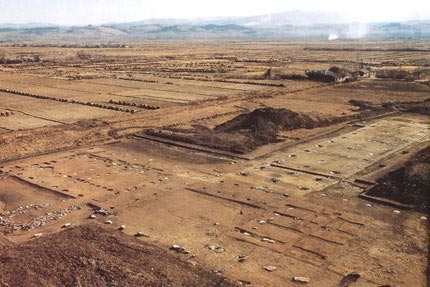
The ancient city relics of the Tang Dynasty (AD 618-907) were made
in Yanbian, northeast China's Jilin Province, in a small village
called Xigucheng.
The village was called "
cheng," meaning "city" in Chinese,
because it used to be a great city in the Tang Dynasty (AD
618-907). It was the Zhongjing (central capital) of the Bohai
Kingdom, which occupied Northeast China, the sea-border areas of
Russia and part of the Korean Peninsula from AD 698 to 926.
According to historical annals, the kingdom, built by the Mohe
ethnic group, was an autonomous power under the Tang Dynasty. It
reached its peak of prosperity while trading with Russia, Japan and
the Korean Peninsula, and its capital was built in the style of
Chang'an (today's Xi'an), the Tang capital.
In AD 926, the Khitan army surrounded the grand capital of the
kingdom.
Historical records say that, after days of fruitless struggle,
the Bohai king walked along the city's Phoenix Avenue, wearing
white robes and holding white banners, and surrendered before the
horse of the Khitan king.
Three years later, the Khitans forced 94,000 Mohe households to
move south to today's northeast China's Liaoning Province. To
prevent the Mohes from returning to their hometowns, the Khitans
burnt down the magnificent Bohai capital.
About 400 years after the fall of their kingdom, Mohes
disappeared from the history books. Some scholars believe Koreans
surnamed Tai descend from the Mohes.
Today, only the ruins of a few palaces in the kingdom's capital
have been brought to light.
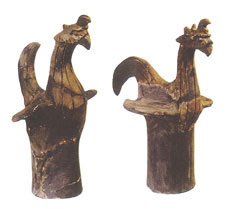
But archaeologists have found at the latest site a glazed green
porcelain artifact in the shape of an animal head, according to
Song Yubin from the Jilin Provincial Archaeological Research
Institute.
With its clenched big, sharp teeth and flying horns, the
dragon-like animal combines the Tang style with those of the ethnic
culture.
8. Imperial palace relics of the Jin Dynasty (1115-1234) in
Heilongjiang Province
The Liuxiu Village Palace site in Northeast China is the remains of
a grand palace in Acheng, Heilongjiang Province. The palace,
covering 50,000 square meters, was built by the Nuzhens in the Jin
Dynasty (1115-1234).
The palace site, facing the southeast, consists of a main hall,
corridor, back chamber, frontispiece and cloister. The frontispiece
lies in the middle of a northeast cloister; the main hall,
symmetrical with frontispiece, lies in the northeast cloister; the
back chamber lies behind the main hall; the corridor connects the
main hall and the back chamber; the cloister is a square and the
each side is 184 meters long.
The Liuxiu Village Palace makes great contributions to knowledge
of the political system, religions, customs and architecture style
of the time.
9. Ancient brewery plant of the Yuan Dynasty (1271-1368) in
Jiangxi Province
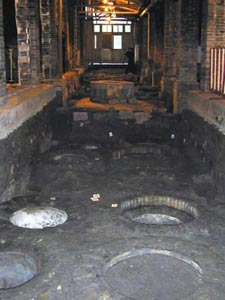
So, to the ruins of a 700-year-old spirit distillery in Lidu,
central China's Jiangxi Province.
The distillery, covering 15,000 square meters, retains its original
well, cellar, stoves, pipelines, distilling equipment and walls. In
the Yuan (1279-1368) and Ming (1368-1644) dynasties, the Chinese
made many tons of high-quality spirits with
gaoliang
(Chinese sorghum) there.
The discovery helps end the argument over the origin of
distilled spirits in China, said Liu Qingzhu, director of the
Archaeological Research Institute at the Chinese Academy of Social
Sciences.
Chinese legends said liquor was first produced in the Xia
Dynasty in the 21st century BC.
But the alcohol our ancestors drank before the 13th century
might not have been as strong as the spirits we have today, said
Liu.
10. Storehouse relics of the Yuan Dynasty in Ningbo City of
Zhejiang Province
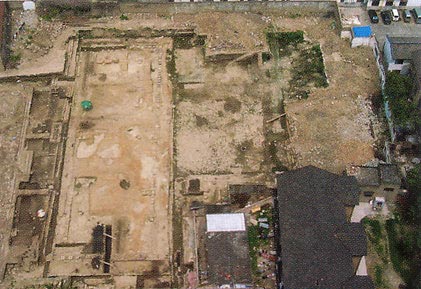
Relics from a Song Dynasty (960-1279) porcelain warehouse in
Ningbo, east China's Zhejiang Province, also make the list. The
Yongfeng warehouse relic site lies right in the center of Ningbo
city, and won protection only after a fierce battle with
construction developers.
Upon discovery of the relic site, the institute immediately
provided a detailed proposal demonstrating to the municipal
government that the site was worth protecting, and argued that a
relic site park should be built instead of a new neighborhood.
After several months of debate, and with the support of many
local people, who called the mayor’s hotline, e-mailed or wrote
letters, the municipal government finally decided to refund the
developer 60 million yuan, and contributed a further 40 million
yuan for the construction of the relic theme park.
Up until November 2001, the excavated field expanded to 1,000
square meters and excavated a great deal of relics. The excavation
work restarted in March 2002, and the excavated area expanded to
2,500 square meters. There was found the local government-owned
storehouses of Song, Yuan and Ming dynasties which centered on the
Yongfeng storehouse in Qingyuan Street of the Yuan Dynasty and a
lot of porcelain work from famous kilns in the Central Plains of
the Song and Yuan dynasties.
It’s the most famous archeological finding in Ningbo city and
it’s very important for archeological knowledge of ancient
architecture of the period. The Yongfeng storehouse was perfectly
preserved. It’s the first time a large-scaled storehouse site was
found in China.
(China.org.cn)