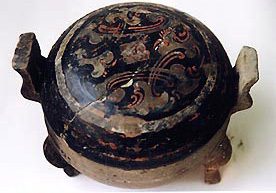
1. The Neolithic Site at Gaochengdun in Jiangyin, Jiangsu
Province.?
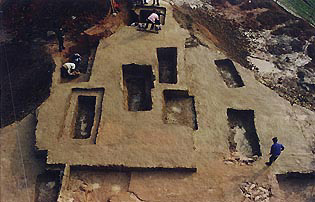
This is a large-scale high terrace graveyard of the Liangzhu
Culture, with rigorous layout and planning. An area of about 1,000
square meters has been excavated. In 1999, a total of 13 large and
middle-sized tombs of the early and middle stages of the Liangzhu
Culture were excavated and screened, from which a total of 155
pieces (sets) of various kinds of jade articles, and stone and
pottery wares were unearthed. Within the cleared graveyard area of
400 square meters, the tombs were distributed in the form of a
herringbone facing the northwest and northeast. The site is
extensive. The No.13 tomb is so far the largest ever found of the
Liangzhu Culture, and is one of the best preserved. Its scale and
burial objects may indicate the high social position of the
occupant. The few but high-quality jade articles used as burial
objects may symbolize another type of funeral of the Liangzhu
Culture.
The southern part of Jiangsu Province where Gaochengdun is
located is a very important region on the Lake Taihu Culture rim.
The discovery of the site shows that the position of the southern
part of Jiangsu in the Liangzhu Culture cannot be neglected. It may
represent another center similar to the important position of the
Ningzhen and Shanghai Fuquanshan areas.
2. Relics at Wanfabozi of Tonghua, Jilin
Province.?
The excavation covers an area of more than 6,000 square meters. The
site has rich cultural accumulations, covering the period from the
Neolithic Age to the Shang and Zhou, the periods of Spring and
Autumn and the Warring States, the Western Han, the Wei and Jin and
the Ming dynasties.
The burial forms are unique, including earth pit graves, stone
coffins in earth pit graves, stone outer and inner coffins in earth
pit tombs, tombs covered with a large stone, group of stone tombs
with large stone cover, group of stone tombs, and group of stone
tombs with steps and platform. Also found was a tomb containing 40
corpses, mostly women. The group of stone tombs and the group of
stone tombs with steps and platform reflect a special style of
funeral during the Koguryo period.
The six archaeological cultural remains classified during this
excavation represent six new types of cultures. The remains of the
Neolithic Age with distinct relationships between levels and
positions are the first find in the southern part of Jilin
Province. The find of a pottery li (cooking tripod with
hollow legs) of the second stage of the Bronze Age disproved the
conventional hypothesis of no li being used on the middle
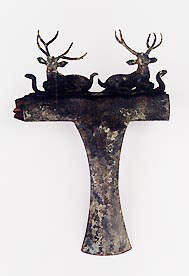
and upper reaches of the Yalu River. The unearthed third stage
bronze short sword and the cast models show that the casting
industry had appeared in the region during the Spring and Autumn
and Warring States periods. The fourth-stage trenches around
mountains show that the site was a large village during the Western
Han Dynasty. It is presumed that it dates from the early stage of
the Koguryo period. The pottery wares of the fifth stage date from
the middle and late stages of the Koguryo period, showing a blend
of the Central Plains and local cultures. The division of stages of
the remains linking the Koguryo culture with the local culture of
the Bronze Age will have an important impact on the study of the
Bronze Age in the Northeast Asia and the remains of the Koguryo
period.
3. Large Graveyard at Yangfutou, Yunnan Province.
This graveyard covers a total area of more than 40,000 square
meters, 10,700 square meters of which have so far been excavated. A
total of 488 tombs of Yunnan culture and 36 Eastern Han tombs have
been verified and examined.
The Yunnan culture tombs are divided into large, middle-sized
and small ones. In the large and middle-sized ones, there are
coffins. The funeral customs vary and some are unique. The
overlapped burial tombs contain at most five layers of corpses. In
addition, there are joint burial tombs, group burial tombs and
accompanied burial tombs. The burial objects include bronze tools,
weapons, farming tools, and large amounts of enamel, wooden, jade
and stone articles, as well as silver and gold fittings, totaling
about 4,000 pieces. Particularly, there are a large number of
well-preserved weapons with enameled wooden handles, tools, farming
implements and a set of enamel and wooden sculptures with varied
shapes and colors. They are the first relics unearthed in Yunnan
Province containing enamel and wooden articles. They also provide
substantial data for the study of farming tools and the technique
of connecting metal spearheads to wooden handles.
The graveyard clearly demonstrates the blending of Yunnan
culture over a long period of time with Han culture, providing
important evidence for the study of the influence on frontier
regions exerted by the culture of the Dianchi Lake region and the
Central Plains culture.
4. The Sui and Tang Grand Canal in Huaibei, Anhui
Province.
Eight sunken ships of the Tang Dynasty and a stone wharf of the
Song Dynasty were discovered on the south side of the original
course of the Grand Canal. In 1999, three of the sunken ships were
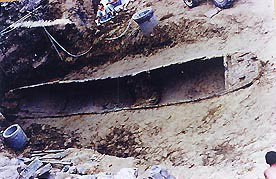
excavated. The No. 1 sunken ship was made of timber. It is in a
rectangular form, and the bottom and stern of the ship remain in
fairly good condition, with a complete rudder. On the crossbeam of
the stern chamber there are three casements in which the handles of
the rudder were placed for the change of direction. The No.2 ship
is a dugout canoe made from a whole tree trunk. The No.3 ship
consists of only half of the hull, with a section of the bottom
attached to it.
The rectangular stone wharf is situated on the south bank of the
canal. Its east and west sides were reinforced with rammed earth.
It was a wharf for handling goods. This was the first discovery of
a relic of construction on the Sui and Tang Grand Canal.
Liuzi County was an important town on the Tongji Water Channel
during the periods of the Sui, Tang and Song. The excavation shows
that the county had had a transient goods wharf and had been a
large hub of commerce and travel.
A great number of valuable fine porcelain wares produced by
various kilns of the Tang and Song were unearthed. The articles, in
various shapes, are in good condition, and most of them are of the
best quality. Particularly, the discovery of porcelain ware of the
Liao Dynasty on the Grand Canal in the Huaibei, Anhui Province,
will provide valuable materials for the study of communications
during the Yuan and Song dynasties.
5. Mountain City at Wunushan, Liaoning Province.
An investigation and partial excavation of an area of about
500,000 square meters of the project of the boot-shaped mountain
city have been made. Against a background of mountain cliffs, the
city were guarded by stonewalls along the smooth and gentle curve
of the mountain.
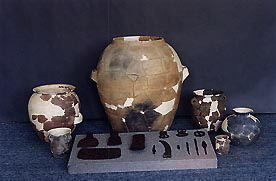 |
The city has three gates, and was divided into two sections, the
part on the mountain and the part at the bottom. On the mountain,
there is a watchtower, water reservoir, and barrack-like groups of
buildings, as well as remains from the late Neolithic, Spring and
Autumn, Warring States, Western and Eastern Han, Wei, Jin and Liao
dynasties. About 1,000 pieces of various relics, including pottery
wares, stone, porcelain, bronze and iron articles were unearthed.
After the excavation, the dimension, layout and structure of the
mountain city were verified, and the specialty of construction and
execution method of the construction of the early mountain city of
Koguryo were identified, which provides important evidence that the
mountain city, or Qishenggu City might have been an early capital
of Koguryo. This is a new find in the northeast area.
The Neolithic cultural remains, particularly the discovery of a
group of sites and relics of the early Koguryo period, have
provided new materials for dating the Koguryo culture in the region
to an earlier period, for the establishment of the chronology of
the ancient culture of the Huanren region and the study of its
cultural genealogy.
6. The Yu Hong Tomb of the Sui Dynasty in Taiyuan, Shanxi
Province.
The tomb is a single chamber grave built with bricks and with a
sloping passage leading to it. It is a plain square with arched
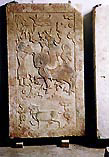
sides. The relics include a white marble coffin, octagonal white
marble columns and a stone sculpture of the heads of people
offering a sacrifice. The most valuable aspect is the relief
patterns on the base and four sides of the coffin, with color or
gilt painting. The decorative figurines, costumes, fittings,
vessels, flowers and birds in the patterns bear a strong flavor of
Central Asian culture.
This tomb is so far the only archaeological find in the Central
Plains region that reflects Central Asian culture. It is also the
only one to have been excavated in a scientific way and with an
accurate chronological record. It is rich in relics and has been
well preserved. It is of great significance in the study of the
cultural exchanges between China and Western countries during the
Northern Dynasties and the Sui Dynasty, studies of the Silk Road
and studies of the history of Jinyang City.
7. The Central Capital City (Zhongdu) of the Yuan Dynasty in
Zhangjiakou, Hebei Province.
With a surveyed area of 300,000 square meters in Hebei Province,
the ancient capital city was constructed with one inside city
enclosed by an intermediate city and another outer city. The
excavation site covers an area of 1,430 square meters. During the
excavation, a platform of the central palace of the inside city, a
superb palace gateway and a corner terrace structure of a special
shape were found, and a great amount of valuable building
components and materials including stone, ceramics, iron, bronze
and wood were collected.
The foundation of the Yuan Dynasty city, two to three meters
above the ground, and the specially styled rammed corner terraces
in the inside city have provided evidence to identify the city
structure and disposition, and the building layout. The survey
shows that there were four gates in the inside city, three gates in
the intermediate city, a waterway, and in the best preserved
location of the outer city, remains of the ruined rammed terraces
of a city wall about one meter high can be seen. In the three
cities, ruins of buildings were also found, including the
foundations of a group of I-patterned principal palace
constructions with distinct central axial alignment and symmetric
distribution of buildings. The unearthed high quality building
materials and components include corner designs of exquisitely
carved white marble heads (without horns) of dragons, glazed beasts
and a relief dragon design on the tile-ends.
The discovery provides new and substantial evidence for the
study of the capital of the Yuan Dynasty.
8. A Distillery in Chengdu, Sichuan Province.
The verified area covers 1,700 square meters, 280 square meters of
which have been excavated. The exposed remains include three
air-drying halls, eight wine cellars, four fermentation ranges,
four ash pits and road foundations, wooden pillars and the
foundations of distillation facilities. Large numbers of blue and
white porcelain shards produced in the Ming and Qing dynasties were
unearthed.
The discovery of the site disclosed the whole process of
distilling and liquor production during the Ming and Qing
dynasties. The site was composed of a wine shop in front and a
brewing workshop in the rear. The air-drying halls, wine cellars,
and the fermentation ranges were located in the rear. The road and
pottery and porcelain food and drink vessels collected from beside
the distillery are assumed to be from the wine shop facing the
street.
The Shuijingjie Street Distillery (Quanxing Distillery) site was
located by the original cellar of the Quanxing Distillery that is
still in production today. From the underground accumulations of
relics and the order of sequence of articles and objects,
researchers have identified a chronological chain ranging from the
Ming Dynasty to the present day, showing continuous production of
liquor here for the past 500 years. This is the only example of
winery production and business in ancient times ever found in
China.
9. An Early Shang City Site in Jiaozuo, Henan
Province.?
Excavated in 1999, the Shang relic at Fucheng of Jiaozuo, Henan
Province covers an area of about 1,700 square meters. In the middle
section of the site, an early city site of the Shang Dynasty with
rammed foundations and house bases was also found.
The city was in the form of a square. Its extant western wall is
about two meters high, 300 meters long and 4-8 meters wide. The
remaining north city wall is about 300 meters long, and two to
three meters high. The restored eastern wall is about 300 meters
long. Only the underground trenches of foundations of the south
wall remain. The foundation trenches, about 15 meters wide and 0.9
meters deep, were dug first, and then covered with planks and
rammed tight with earth.
The No. 1 rammed foundation is located at the northeast section
of the city, in the form of a rectangle, 70 meters long from south
to north, and 40 meters wide from east to west. The site was
divided into two compounds, in the center of which was the
principal hall. Under the Nos. 1, 2 and 3 foundation sites, a layer
of the Erlitou Stage Culture was overlapped. The unearthed pottery
wares mainly include gray clay pottery, deep-bellied jars with
round bottoms, round-bellied jars, molded-mouth jars and bigmouth
wine vessels (zun), which are similar to their counterparts
of the Erlitou Culture.
The Fucheng early Shang site is another important discovery
following the discoveries of the Shang city sites at Zhengzhou and
Yanshi in Henan Province. The new discovery is of significant
academic value for the study of the early Shang culture in Henan
Province, and the material culture and social life of the time.
10. The No.1 Han Tomb at Huxishan in Hunan
Province.?
This is the second tomb of a marquis of the Han Dynasty excavated
in Hunan area that had not been robbed, following the first Han
tomb excavated at Changsha in the area. This tomb is a rectangular
shaft pit, with a sloping passage to the grave. There are two side
chambers, in the south and north respectively. The coffin is still
well preserved. The burial objects were mostly placed in the four
chambers and in the coffin, including the outer coffin.
The 500 unearthed objects include enamel wooden articles,
pottery wares, bronze mirrors, jade seals, and bi (a round
piece of jade with a hole in the center). Also, nearly 1,000 bamboo
strips were found in the tomb. The articles were exquisitely
produced with a great number of needle-incised patterns. The
beautifully written characters on the bamboo strips are clear
enough to read. Their contents involve four major categories,
including books, homilies, general household register and cuisine.
The last two are particularly important. The general household
register recorded the number of households of various townships in
the state of the Yuanling marquis in the Western Han Dynasty. The
cuisine section records the materials and ingredients of various
dishes and cooking methods, filling a gap in our knowledge of
ancient cuisine.
The occupant of the tomb was Wu Yang, son of Wu Chen, king of
Changsha. He was the first Yuan Ling marquis, having received the
title in the first year of the reign of Gaohou (187 BC). He died in
the second year of Houyuan of the reign of Emperor Wendi, which
means that he had been on the throne for 25 years. The excavation
of the tomb provides most valuable materials for the study of the
history of that time.
(China.org.cn)