| Religions practiced in Tibet encompass Tibetan Buddhism, Bon and folk religion, plus Islam and Christianity. At present, there are some 1,700 monasteries and nunneries of Tibetan Buddhism in the region, with 46,000 resident monks and nuns; 88 monasteries of the Bon religion, with some 3,000 resident monks, 93 Living Buddhas and over 130,000 religious followers; four mosques, with some 3,000 followers; and one Christian church, with over 700 worshippers.

Lamas blowing conch
The social influence of these religions varies with the regions. The influence of folk religion can be found only in the remote areas. As a result, it is very often ignored in Tibet as, unlike Tibetan Buddhism, the Bon religion, Islam and Christianity, it lacks theory, special venues for rituals and religious organizations. Tibetan Buddhism and the Bon religion are opposing faiths, although they have long exerted influence on each other. Thus parts of the Tibetan Buddhism can be found in the tenets of the Bon, and vice versa. Both have absorbed the cream of the folk religion, such as worship of certain folk spirits. Islam and Christianity are small in the number of followers and influence in Tibet. They are practiced only in a limited area. However, they do exist and live harmoniously with Tibetan Buddhism and the Bon religion. Folk religion is still influential among the Tibetan folks.
Tibetan Buddhism
In the early 7th century, Buddhism made its way into Tubo (the old name of Tibet) from Nepal and China's Central Plains (the middle and lower reaches of the Yellow River). Songtsan Gambo, the Tubo king, married Princess Wencheng of the Tang Dynasty (618-907) and the Nepalese Princess Bhributi. Each princess brought to Tubo a statue of Buddha, and their accompanying artisans built the Jokhang and Ramoche monasteries in Lhasa to house them. Their accompanying Buddhist monks then set about translating Buddhist scriptures.
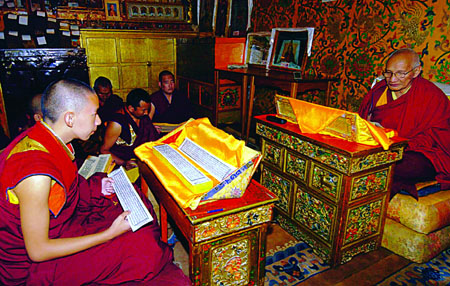
The 11th Panchen Erdeni studies sutras very hard.
Buddhism first became popular among the nobility and then gradually spread among the common people in the 7th century, but it collided with the Bon religion then holding sway. For hundreds of years, Buddhism absorbed many contents of the Bon religion and the folk religion. Gradually, strongly influenced by cultures of the surrounding areas, Buddhism in Tibet grew to possess voluminous classics, rich scriptural tenets, a sound monastic system, a strict sutra study system and meditation system; later, the Living Buddha reincarnation system emerged. Finally, it became a special branch different from the Han Buddhism and Pali-language Buddhism-Tibetan-language Buddhism also known as Lamaism.
Through long-time evolution, Tibetan Buddhism was split into many sects, mainly Nyingma (known as the Red Sect), Sagya (known as Colorful Sect), Gagyu (known as the White Sect) and Gelug (known as the Yellow Sect). Of all the sects, Gelug, founded by Zongkapa after his religious reform in the early 15th century, was the most powerful. The two major Living Buddha systems, Dalai and Panchen, came from the Gelug Sect.
Through a prolonged period of cultural exchanges, Tibetan Buddhism is practiced mainly in China's Tibet as well as Qinghai, Gansu, Sichuan and Yunnan Provinces, plus areas concentrated with such ethnic groups in China as the Mongolian, Tu, Yugur, Lhoba, Moinba, Naxi, Pumi and Han. It has worshippers also in Bhutan, Nepal, Mongolia and Russia.
During the heyday of Tibetan Buddhism, each Tibetan family was required to provide at least one member to become a monk or nun. This is why Tibetan monks and nuns made up 25 percent of the Tibetan population in the 16th century and thereafter. In 1951 when Tibet was peacefully liberated, there were 100,000 monks and nuns, or over 10 percent of the Tibetan population in Tibet. After the Democratic Reform in 1959, all monasteries went through reform according to suggestions by the 10th Panchen Erdeni. Tibetan people have since enjoyed freedom to be lamas or resume secular life.
|
Living Buddha Reincarnation
Tibetan Buddhism has many sects, which have introduced their own system for disciples to take over the teaching from their masters so as to safeguard their established interests and defend their own rule. This constitutes one of the social factors contributing to the introduction of the Living Buddha incarnation system.?
Garma Gagyu was the first among the various sects of Tibetan Buddhism to introduce the Living Buddha incarnation system. In 1283, when Garma Baxi, an eminent monk with the Garma Gagyu Sect who had been bestowed with the title of Imperial Tutor by the Mongol Khan Mongo, was granted a gold-rimmed black hat as the badge of office on his deathbed, he expressed a wish to find a boy as his reincarnation to inherit the black hat. This was the beginning of the black-hat Living Buddha reincarnation system. Other Tibetan Buddhist sects followed suit. The Dalai Lama reincarnation system was introduced in the 16th century, and that for the Panchen Erdeni in 1713. When the Gelug Sect took over power in the 17th century, the Living Buddha reincarnation system became a means employed by those in power in Tibet to seek prerogatives. To turn the tide, the Qing court promulgated the 29-Article Ordinance for More Effective Governing of Tibet in 1793. Article 1 of the Ordinance prescribed the introduction of the system of drawing a lot from the gold urn to determine the reincarnated soul boy of a deceased Living Buddha. For this purpose, the Qing court had two gold urns made: one for the Dalai Lama and the Panchen Erdeni, which is still kept in the Jokhang Monastery in Lhasa; and one for Grand Living Buddha and Hutogtu Living Buddha in Mongolia and Tibet, which is still kept in the Yonghegong Lamasery in Beijing.?
The State respects the faith in and practice of Living Buddha reincarnation, as well as the religious rituals and historical institution of Tibetan Buddhism. In 1992, the State Council Bureau of Religious Affairs approved the succession of the 17th Karmapa Living Buddha. In 1995, the Tibet Autonomous Region, at the approval of the State Council, accomplished the seeking and confirmation of the 10th Panchen's reincarnated soul boy and the conferment and enthronement of the 11th Panchen, after going through the procedure of drawing a lot from the gold urn.?
More than 30 Living Buddhas have been determined as new Living Buddhas with the approval of the State Council and TAR government following the end of the Democratic Reform in 1959. |
Bon Religion
In the 5th century BC, Prince Sinrao Mibo of the ancient state of Zhangzhong founded the Bon religion on the basis of an existing primitive religion unique to Zhangzhong. It conducted rituals mainly in the Montog area of Gar County primarily to pray for luck and for dispelling evil. It gradually spread to the area drained by the Yarlung Zangbo River, becoming a dominant religious force in the plateau.
When Buddhism spread to Tibet, priests of the Bon religion and Buddhist monks fought each other. For the sake of its own survival and development, Bon was forced to absorb, directly or indirectly, contents of Buddhism, such as putting on the kasaya, building monasteries, taking ritual walks, counting prayer beads [although in a way contrary to Buddhists], and reciting the Six Syllable Prayer [with words entirely different from that of Buddhism]. The Bon religion even has its own reincarnated Living Buddha's. Some say the Bon religion has become merely another form of Buddhism, but its followers reject this.
Tibet boasts 88 monasteries of the Bon religion. They include 55 in Qamdo, 23 in Nagqu, six in the Xigaze area, two in Nyingchi, one in Lhasa and one in Ngari.
Islam
Islam has been practiced in Tibet for some 1,100 years. Nowadays, there are more than 2,000 Hui residents in Lhasa, most of them Muslims. A small number of Muslims come from other ethnic groups or from foreign countries. All of them enjoy Islamic life to the full in Tibet.

Muslims in Lhasa
Muslims in Lhasa have adopted the habits of Lhasa in terms of language and garments although they still maintain their own beliefs. While praying, they speak in Arabic first and then in Tibetan. There are four mosques in Lhasa, including the most famous one in Hebaling, located on Barkor Street South southeast of Jokhang Monastery. Built in 1716, it originally had a constructed area of some 200 square meters. It underwent reconstruction in 1793. In 1959, when the Dalai Lama and his men staged an armed rebellion, it was destroyed. However, it was rebuilt in the following year.
Christianity
The only Catholic church is found in Yanjin Village of Mangkam County on the Sichuan-Yunnan border. After Catholicism spread to Yanjin in 1865, there were 17 people who served as priests or missionaries. This area is home mainly to Tibetans. Only a small number of the locals are of Naxi ethnic group. About 80 percent of the population (740) follows the Catholic faith. They recite prayers in Tibetan, and the local believers, like other Tibetans, celebrate the Tibetan New Year while taking Christmas as the most important holiday. While celebrating Christmas, however, there is no Christmas tree and no Santa Claus. A priest presides over the mass and gives a sermon. All the Catholic faithful gather in the courtyard of the church to dine and the party ends with Gozhuang and Xuanzi dances. When the nearby Gangda Monastery celebrates its Sorcerer's Dance, the priest and laity are invited to watch. |