

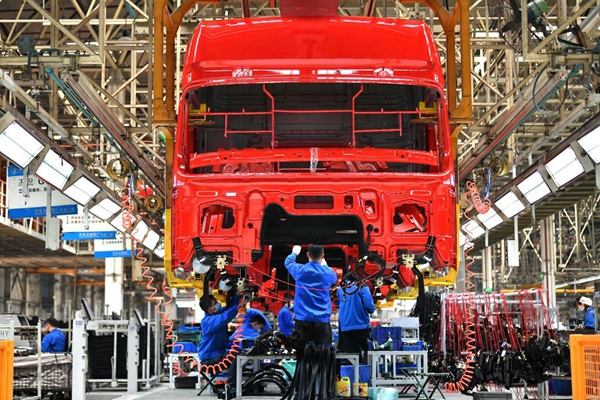
Employees work at a heavy-duty truck assembly line of Shaanxi Automobile Holding Group Co., Ltd. in Xi'an, capital of northwest China's Shaanxi province, April 23, 2020. [Photo/Xinhua]
Editor's note: Zhou Muzhi, head of Cloud River Urban Research Institute and professor of Tokyo Keizai University, and Yoshinori Yokoyama, an adviser of the Office of the President of the University of Tokyo, weigh in on the prospect of globalization amid the COVID-19 pandemic.
What now for global supply chains
Zhou Muzhi: The impact of the COVID-19 pandemic on globalization has been a major concern of the international community. Globalization is a multi-dimensional concept, and supply chains are one of the integral aspects of globalization. My prediction 20 years ago was that the global expansion of supply chains would help form global supply chain-based industrial clusters, and then megalopolises, in China's Yangtze River Delta, Pearl River Delta, and the Beijing-Tianjin-Hebei region. The prediction has been confirmed over the past two decades, as huge global industrial chain-based industrial agglomeration formed in the regions, and the three megalopolises have gradually taken shape and driven China's social and economic development. What concerns the public most is the COVID-19 pandemic, the U.S. policies of bringing its manufacturing back, and the impact of the policies on globalization.
Yoshinori Yokoyama: We should pay attention to the concept of "regionalization" when it comes to discussing about the characteristics of "globalization," as the two are complemental and mutually reinforcing notions as opposed to nationalization which is sometimes a hindrance. This is true with regard to the supply chains.
Zhou Muzhi: In fact, some problems in global supply chains had emerged before the outbreak of COVID-19, as seen in China-U.S. trade frictions. In the past, manufacturing supply chains were confined to one country or even a certain region. For example, Toyota's supply chains were basically in areas with a radius of 50 kilometers. The global expansion of supply chains coincided with China's reform and opening up, making China a major beneficiary of the trend. From 2000 to 2019, the export volume of China increased 10 times. The three main drivers of the expansion of global supply chains were information technology revolution, transportation revolution, and the sense of security brought along by the stable world order after the Cold War. Global supply chains broke the deadlock of high labor distribution rate of industrial countries in the West, and changed the mechanism of global wealth creation and distribution.
The Chinese economy has largely benefited from global supply chains to achieve its rapid development. Therefore, in the book "The Chinese Economy: Mechanism of Its Rapid Growth" published in 2007, I used the entire first chapter to explain the relationship between China's economic development and global supply chains. However, the recent years have witnessed frictions between China and other players on the global supply chains. First, international capital felt uneasy about government intervention. For example, to avoid over-dependence of its supply chains on China, Japan rolled out its "China plus one" policy, which encouraged its companies to build supply chains in countries and regions outside China. The second issue is intellectual property rights, which is one of the focuses in the China-U.S. trade frictions. The third one is the rising costs of labor and land as well as taxation.
Of course, the U.S. and other Western countries are facing with the woes of industrial hollowing-out, which constitutes the important social foundation that helped Donald Trump win the election.
Yoshinori Yokoyama: Another issue is China's rapid rise in global influence and presence. When the concept of globalization was born, I interpreted it as "global Americanization." However, as China expands its influence on the world stage, the U.S. grows increasingly sensitive in many aspects. I have been proposing regionalization as a measure to counterbalance the process of globalization, and I believe that regionalization, or regionalism, is an idea that favors regional characteristics, but coexists with globalization in a mutually reinforcing fashion. At the same time, we should be fully aware of the nationalist sentiment that goes against globalization.
Respect for intellectual property rights is a constantly evolving process. Today, China already has many strengths in the field of intellectual property rights, and will have a better understanding why it is necessary to protect intellectual property rights in the future.
Zhou Muzhi: The development of global supply chains accelerates the industrial hollowing-out in the old manufacturing base of the U.S., and Donald Trump's election was in some sense a result of rising nationalism in these Rust Belt states.
During the 40 years of reform and opening up, especially the nearly two decades since China's entry into the World Trade Organization, China has made tremendous achievements with great efforts and built up confidence in its development. However, China's confidence seems yet to be appreciated by the rest of the world, and thus, has triggered some negative sentiments in some people. If not properly handled, this mismatch of confidence and negative sentiments may distort China's relations with the rest of the world.
Yoshinori Yokoyama: In fact, it was not plain sailing for the U.S. and Japan to be accepted by the outside world in the process of their ascent. The U.S. became the largest creditor nation in the world in the 1930s after World War I, before which Europe was the center of the world. It was until the 1950s when the U.S. formed its own distinct style in many fields such as music, arts and architecture, and the number of Nobel Prize winners in the U.S. soared after World War II. Despite of all of this, Americans were called "ugly Americans" for a long time, and Japanese were also called "ugly Japanese" in Europe and America in the 1980s.
Facing this situation, shall we confront it or display complementarity? These two approaches show the difference between narrow nationalist sentiment and regionalism that emphasizes regional characteristics. For example, China has attached great importance to the development of digitalization in recent years, while Japan still fond of the analog world before digitalization. As a result, Japan's manufacturing industry has a solid foundation, but the labor productivity of its service industry seems to be a bit stagnant. Only very recently with the experience of COVID-19 showed vividly this problem of inertia of old ways of doing things. China made Japan to be aware of that. China and Japan have their own unique characteristics, and possible complementary relationship which are the regionalism advocates.
Zhou Muzhi: Therefore, globalization and regionalism are a pair of complementary relations. However, narrow nationalism goes against and harm globalization. How to curb narrow nationalism and make the world more secured is the key for all countries to maintain and develop the global supply chains and promote globalization.
Yoshinori Yokoyama: In terms of response to COVID-19, putting a country or a city on lockdown is a form of strengthening national intervention, which may lead to the rise of narrow nationalism. Someone would be worried about it, but I think the sentiment would wane sooner or later.
Manufacturing evolves into interaction economy
Zhou Muzhi: Everyone is talking about the U.S. policy of getting manufacturing back. As an economist keeping a close eye on the development of industrial chains, I think that even without Trump's strong push, the return of the manufacturing industry to the West to some extent will occur naturally.
Historically, the earliest globalization of supply chains started from agriculture. The earliest merchandises for trade between the East and the West in ancient times were agricultural products, such as silk, pepper, cotton, sugar, and tea. Obtaining these agricultural products from other regions was the driving force behind the Great Navigation pushed by Western countries. The globalization of food supply chains has boomed ever since then.
My hometown Hunan is the birthplace of rice civilization and used to be typically a self-sufficient economy, with almost all of the food produced locally or purchased from the surrounding market. The dynamic line of the supply chain in my hometown was short and visible. However, the food supply of Chinese people nowadays has gone beyond regions, rendering its dynamic line invisible and non-traceable.
Japan's countryside has a typical rice civilization. Its original scenery was very similar to Hunan, and it also depended on typical self-sufficient agriculture. However, calculated by kilocalorie, 60% of Japanese food today is imported.
Although globalization makes food supply more efficient, it has dealt a heavy blow to rural areas, agriculture and farmers of China and Japan depending on small-scale peasant economy. Even under the auspice of the much-maligned protection policy, Japan's agriculture is in danger of being squeezed by imported food. More importantly, the invisibility of the supply chain makes the hidden risks of food safety non-traceable and uncontrollable.
In recent years, good changes have taken place in Japan's food supply, as more farmers bypass the intermediate link to sell to consumers directly. Post-war agricultural cooperatives and supermarkets that promoted the scale and efficient supply of agricultural products were skipped directly. "Visible farmers' agriculture" adds communication, trust, sensibility and quality to agricultural products, which not only improves the value of agricultural products, but also makes agriculture itself more attractive. As a result, the number of female students majoring in agriculture has increased significantly in Japan recently, and more and more young people are going to the countryside.
Yoshinori Yokoyama: In Japan, both agriculture and the fishing industry are exploring a new type of producing and circulating system that interacts with consumers. Some people call this industrial form of production. In other words, fishery is changing from hunting to farming and farming is changing to "manufacturing." Or, we should not use the word industry which could be replaced with the notion of "social systems." They are transforming themselves into "food delivery systems" as one of social systems such as medical systems, information systems, transportation systems and financial systems.
Zhou Muzhi: In developed countries, the production and consumption of the manufacturing industry have encountered similar situations. In regard to the supply chain of manufacturing in the past, a high proportion of information exchanged between enterprises was tacit knowledge that must not and cannot be transferred to others. In order to ensure the confidentiality of tacit knowledge and smooth communication, enterprises preferred long-term cooperation and capital support. The relationship between enterprises in the supply chain was pyramidal. Information technology has greatly reduced the proportion of tacit knowledge through standardization and digitalization, and greatly reduced the time and cost of information exchange between enterprises. At the same time, the mode of module production disclosed its design rules, so that global enterprises can participate in the supply chain competition fairly. Therefore, the supply chain can break through the shackles of tacit knowledge and expand globally. The relationship between enterprises in the supply chain has also changed from a close pyramid to a flat network, which provides the preconditions for developing countries to participate in the global supply chains. At the same time, the participation of China and other developing countries has led to a substantial drop in prices of industrial products. This kind of global supply chains which minimizes tacit knowledge is a typical interaction economy.
As the times change, consumers who used to pursue low prices begin to value emotion, personality, and interactivity with manufacturers. The broader background that makes this possible is that the modularization of industrial production has entered a new phase. The precondition for the new industrialization of developing countries is essentially built on the fact that modularized manufacturing enables unskilled workers to take on industrial activities such as assembling, which is the foundation for the globalization of manufacturing chains. Nowadays, modularization in conjunction with personalized design can lead to diversified and personalized small-scale production. Based on modularization, manufacturers and consumers can produce more stylish and personalized products through interaction.
Yoshinori Yokoyama: Japan is a leading country in the interactive development of modularization and personalization, or custom design. Building a house is a good example. Traditionally, in Japan, there has been a modular system based on 3 feet by 6 feet module. Today, through the personalized, or custom design featuring interaction between clients and designers/architects, modular production of prefabricated building units and components in factories, and seamless assembly by skilled construction workers on site, it not only achieves efficiency, but also realizes the personalized taste of home owners.
Zhou Muzhi: It was the Japanese manufacturers who first and best combined individualized customization and assembly line production in auto manufacturing.
Yoshinori Yokoyama: The new type of manufacturing supply chain is a new system characterized by interaction between consumers and producers while maintaining the improved efficiency. The return of manufacturing to the U.S. or Japan is certainly not relocating factories, but building a new supply chain system.
Zhou Muzhi: We can imagine that the future manufacturing will realize the global supply of high-tech core modules like semiconductor chips on one hand. On the other hand, on the basis of core modules, users interact with manufacturers to produce personalized end products, and the latter's dynamic line of supply chains will be short and visible. The current return of manufacturing to developed countries is largely a return to the market, which means getting close to consumers. Even if there was no Donald Trump or the COVID-19 outbreak, the return would still take place, which is a demonstration of manufacturing's evolution from trading economy to interactional economy.
Yoshinori Yokoyama: As labor cost advantage diminishes in China, and labor cost as percentage of manufacturing cost also diminishes, it is inevitable for some manufacturers to leave China to alleviate an over-dependence in one country. China should be wary of the return of advanced manufacturing to developed countries.
In addition, we need to pay attention to the importance of non-digital accumulation of knowhow and expertise which is difficult, at least for some years to be replaced with current level of so-called AI. For example, the complete digitalization of the production of optical lens is hard to achieve, as it requires exquisite integration accumulated expertise and digital technology. After all, light is not digital outside of quantum mechanics scale. In this regard, Sony, Olympus and other Japanese manufacturers regard the development and inheritance of this kind of expertise in the optical field as their core competitiveness.
Zhou Muzhi: The production of terminal products in the manufacturing industry will become more and more personalized and localized, while the core components and modules are supplied globally.
Therefore, I recently proposed to President of Broad Group Zhang Yue to focus on developing ozone sensors. If the cost of an ozone sensor can be reduced to less than US$100, it can be used in mass quantities in manned space to curb the indoor spread of the novel coronavirus. Moreover, Broad Group is expected to become a global enterprise boasting core components by supplying sensors to ozone equipment manufacturers around the world.
Yoshinori Yokoyama: A similar case in Japan is Murata's capacitor, which has the largest market share in the world. The company is now the world's leading manufacturer of key electronic components.
Zhou Muzhi: The interaction economy of manufacturing is essentially the return of some manufacturing industries to the West and the return of market orientation. Therefore, Chin's manufacturing should recognize this in time, strive to evolve and upgrade, strengthen communication and interaction with the market, and reposition its characteristics in the global supply chains. It is happy to note that China has not only solid manufacturing infrastructure, but also a huge market. We believe that China will blaze a new trail in interaction economy of manufacturing.
Display personality based on knowledge of world
Zhou Muzhi: Engines used to be the key to auto manufacturing. In the age of electrical automobiles, the key has shifted to designs.
Yoshinori Yokoyama: Yes, even the sound of closing the car's door is an important element of design, and it can even affect sales. It is a design parameter called sensuality. Other design parameters are engine sound (quietness has not necessarily the highest value), eye levels of the driver seat (SUVs found that) and so on. The comprehensive design ability of the visible parts and the invisible parts becomes increasingly important, which contains characteristics of cultural heritages. For example, in my opinion, the sofa made by Italians is look ordinary sometimes, but, very comfortable, and it is difficult for Germans to make a sofa more comfortable than an Italian sofa.
Zhou Muzhi: So the chairs and sofas in my home are all the works of Italian designer Mario Bellini, who is my good friend. Recently, in the sensibility field that Europe is good at, Japanese manufacturers have gained international recognition for its products such as white wine, whisky, and chocolate. In the ranking of the most popular enterprises among female graduates in science and engineering, there are many food-related enterprises. Emotional women are willing to go to these enterprises, which is a manifestation of sensibility and culture.
Yoshinori Yokoyama: There are increased international people-to-people exchanges for travel, business, academic exchange and other purposes. Hopefully, this trend enhances inter-cultural flexibility. As I said before, globalism and regionalism can go along with each other. We might need to control the nationalism. Sometimes, it goes against globalism.
Zhou Muzhi: There were 400 million international trips 30 years ago, and the figure soared to 1.4 billion in 2018.
Yoshinori Yokoyama: In my opinion, what deserves notable attention is the exchange of professionals with certain cultural backgrounds, such as architects, designers and even doctors.
Zhou Muzhi: Chefs as well.
Yoshinori Yokoyama: Chefs have always made much of traveling after finishing the stage of apprenticeship. They used to be called journeymen to get the broader experience and test their acquired skills during the apprentice period. In the past, young chefs in Japan had to travel to different places and work as hired chefs. When their skills reached a level, they would go back to their hometown and run a restaurant. Now the travel and practice for culinary apprentices and journeymen have been globalized for a long time.
Zhou Muzhi: Several of my friends' children are studying cooking abroad. Some of them have become top chefs. Some of their fathers are famous professors in universities and some are bosses of listed companies.
Yoshinori Yokoyama: Culinary study abroad has brought about the fusion and mutual learning between Japanese cuisine and Western cuisine, but it hasn't led to assimilation. One of the important reasons why Japanese cuisine is popular around the world is that many Japanese chefs promote regional characteristics based on their knowledge about the world. For example, they now use various kind of meat which was not common in a very traditional Japanese cuisine.
Zhou Muzhi: Getting to know the world and getting oneself known to the world is what every responsible country and every responsible individual should pursue in the course of globalization.
Zhou Muzhi is head of Cloud River Urban Research Institute and professor of Tokyo Keizai University.
Yoshinori Yokoyama is adviser of the Office of the President, the University of Tokyo, and co-founder of the Executive Management Program of the Tokyo University. He is also dean of Hiroshima Business and Management School, and former director of McKinsey & Company, Inc. Tokyo Office.
Opinion articles reflect the views of their authors, not necessarily those of China.org.cn.
If you would like to contribute, please contact us at opinion@china.org.cn.


