Technology triggers translation industry bonanza
- By staff reporter Liu Yi
 0 Comment(s)
 Print
Print E-mail China Today, March 6, 2016


Search giant Baidu won in early January second prize at the China 2015 National Science and Technology Awards for its technological development of machine translation. The competitiveness in world markets of the more than 7,000 products, including websites and apps, that the company’s translation system has been applied to or embedded in has dramatically improved. For example, it enables the 1.2 million domestic suppliers on DHgate.com to sell products to more than 10 million buyers in 224 countries and regions.
The recent awards stand as the first occasion whereon an Internet company won the nation’s top scientific prize. It is usually awarded to weightier projects like manned space flights. One of the hardest tasks of artificial intelligence, machine translation has motivated generations of scientists since the end of World War II to study and accomplish language conversion. It was not until 2006, when Google launched its free, statistically based translation software, that man first achieved a breakthrough in this field and applied the fruits of it, on a large scale, to both production and everyday life. In the last few years, other technological moguls like Microsoft have also entered this field with the aim of expediting their global strategies.
Baidu’s winning of the national scientific award highlighted the technological facet of China’s translation industry. Against the backdrop of technological waves and inception of the “Internet Plus,” Chinese translation companies have taken initiatives to utilize new technologies that upgrade their products, processes, and production modes. In 2015, many of them released Internet-based products, such as crowd-sourcing translation platform, and language detection and translation apps.
But more strikingly, high-tech companies that are starting to enter the industry are expanding its traditional business scope. Some even advocate abandoning the old mode.
Technologies Rejuvenate Industry
Zhang Jing is co-founder and CEO of Shanghai Yizhe Info Tech Co., Ltd. The company’s name gives no clue as to its role in the translation industry. In fact, the start-up company aims to provide language assets management with one-stop online solutions that include corpus building, bilingual sentence alignment, private cloud-based translation memory, and integration of computer-assisted translation (CAT) tools.
Zhang’s is one of the many “l(fā)anguage service” companies that have mushroomed over the last several years. As more Chinese companies have gone global, they now need both translators and translation tools to facilitate internal communication and formulate terminologies in order to manage their language database. As these factors are indispensable to departmental efficiency and consistency, they are becoming crucial to trans-national companies. For example, Huawei, the world’s leading telecom equipment manufacturer, has developed a set of language tools to ensure that its 170,000 employers in 156 countries and regions are able to communicate within the same discourse system.
But most companies rely on the market for such services. This resultant strong demand has attracted high-tech companies and technological entrepreneurs like Zhang Jing.
Upon graduation in 2013, with degrees in computer science and economics, Zhang joined Baidu and worked at its online payment department. Just one year later, however, good language service sector prospects prompted Zhang to start in September 2014 his own company. He applied information retrieval technologies to language corpus retrieval and matching. This combination now constitutes his company’s core competitiveness.
|
|
|
Zhang Jing (third left) and his young, keen team members celebrate their company’s first anniversary. |

Zhang Jing attended last year various conferences, symposiums, and workshops throughout the country, to promote his products and also to get a feel for the industry. He admits to having paltry knowledge of the translation industry, but does not regard this as a disadvantage. “Our company’s edge lies in its strong software development capability,” the young entrepreneur said. “My working experience at Baidu has given me a better understanding about most of the Internet and associated technologies.” He added that this high-tech background enables him to transform ideas into tangible products.
The start-up company has in just one year launched several impressive tools. That most popular is the corpus on private cloud. This product allows as many as 50 people simultaneously to retrieve information from and add to a translation memory database. It consequently streamlines efficiency and, as the database is saved on cloud, dramatically reduces the storage budget.
Zhang’s team comprises a modest 10 employees and two interns. Their focus is hence on the Chinese-English corpus, a language duo accounting for more than 90 percent of translation business in China. “It’s a niche market,” Zhang said. “We have few competitors either in the domestic or international market.” Technological strength and a clear market positioning have gained the company a firm market foothold.
Uber-mode Supplants Industry?
The rise of mobile Internet in the past few years has changed the way people connect, and consequently swept away existing modes of industry. Uber, for example, is transforming the taxi industry throughout the world. The ride-hailing app connects drivers and passengers directly, so maximizing efficiency and saving resources.
Inspired by Uber, Zhang Liang and his partner He Ying sensed the opportunities implicit in online interpretation. They set about developing a new app, called “We translators and interpreters.”
“This is an app-based interpreter hailing platform,” Zhang Liang said. On the one side of the platform is a pool of part-time interpreters, and on the other clients who need interpreting services. With just a click, clients can send out an order which interpreters receive in almost real-time, and respond to if appropriate. The interpretation of voice or video calls takes place on the platform.
|
|
|
Zhang Liang (second right) and his translator friends attend the National Entrepreneurship & Innovation Week in October 2015. |
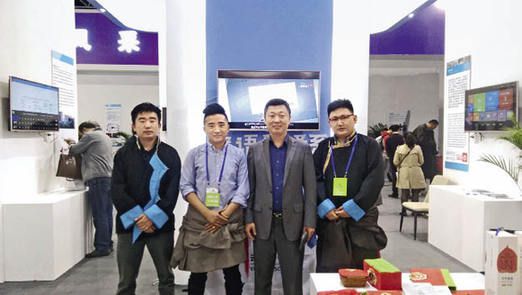
The targets of this new app are informal business talks and outbound tourists – a booming market. Clients demand fast responses, but as their quality requirements are not high the default time span is five minutes. But clients can choose a longer time span if necessary. Typical instances of use for this app include explaining document details, map reading, and ordering dishes from a foreign language menu.
To expand the matching rate, the app encourages clients to input in advance related information like geographical location, accent preferences, and context. It also includes a rating system based on interpreters’ education background, work experience and, most importantly, client evaluation, as does Uber.
“De-centralization is the core value of the Uber mode,” Zhang Liang said. “Passengers don’t need a taxi company to call a cab, so why should I search for interpreters through translation companies?”
Zhang Liang ran a small translation company from 2006 to 2009. He knows the industry well and believes that the existing mode cannot be sustained. “Translation companies keep lowering their quotes to woo clients, but meanwhile increase their commission rates, sometimes up to 50 percent, to profit from translators,” Zhang said. “Consequently experienced translators do not stay, and clients always complain about quality.”
The Uber mode will halt this vicious circle, Zhang said. His new app, through bypassing intermediate companies, can help clients slash budgets and raise interpreters’ earnings. Clients and interpreters can see one another’s information on this open and transparent platform, which helps them strike mutually satisfactory deals. And interpreters can work part-time via smartphones. “They can grab an order as long as they have a spare five minutes,” Zhang said. “As they have professional skills they deserve a higher income.”
Several investment companies have contacted Zhang and expressed interest in the new product. But Zhang Liang and He Ying will select only investors that have similar ideas about sharing economy. “We developed the app not for money’s sake,” Zhang said. “We believe the Internet Plus concept will make the industry more open and fair, so benefiting everyone.”


