
 0 Comment(s)
 Print
Print E-mail China Daily, September 23, 2024


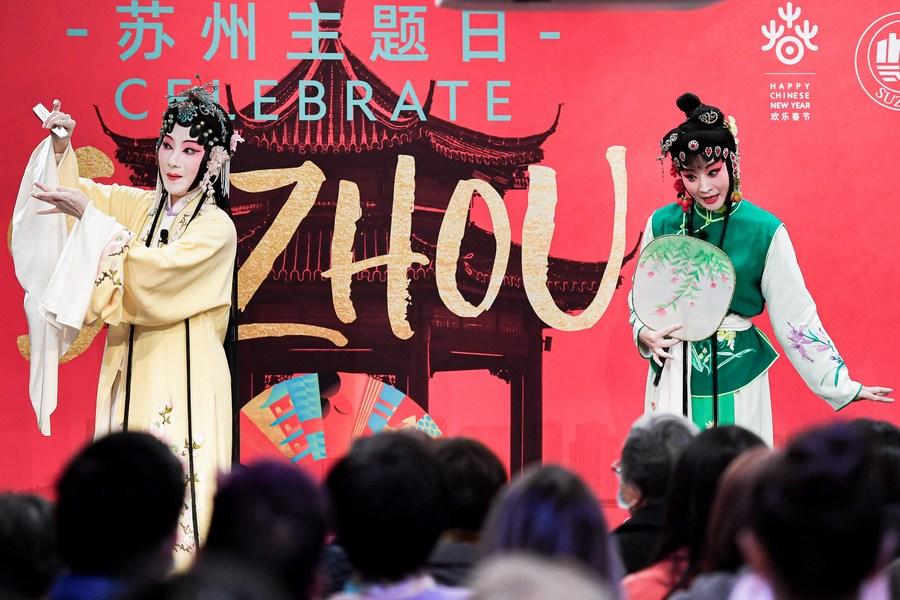
Kunqu Opera performers perform at China Institute in Manhattan, New York, the United States, Jan. 8, 2023. (Photo by Ziyu Julian Zhu/Xinhua)
In Peking University Hall on Sept 13, an air of reflective nostalgia and vibrant enthusiasm enveloped a lecture by Pai Hsien-yung, a distinguished Chinese-American writer, playwright and director.
Pai, 87, a pivotal figure in modern Chinese literature and theater, took the stage to celebrate the 20th anniversary of the youth edition of the Kunqu Opera, The Peony Pavilion, which he produced and adapted. This adaptation of the Ming Dynasty (1368-1644) classic, originally penned by Tang Xianzu, has been instrumental in bridging the gap between Kunqu Opera and contemporary youth culture. The lecture not only commemorated two decades of artistic endeavor but also highlighted the enduring relevance of this timeless tale.
Pai's lecture also opened the latest performances of the youth edition of The Peony Pavilion, which was staged for three days at Peking University from Sept 14 to 16. About 6,000 tickets were sold.
"Time flies. It's been 20 years since we premiered the youth edition of The Peony Pavilion. I am back here today, sharing this production with young people, just like what we did two decades ago," Pai says. "I am a writer and I never expected that my life would be associated with Kunqu Opera closely for such a long time. I consider myself a volunteer in protecting and promoting the ancient art form, which is so sophisticated and beautiful that it would be a great regret if we didn't keep it alive and let it be appreciated by a wider audience."
One of the oldest traditional opera forms still performed in China, Kunqu Opera was born in the region of Kunshan in today's Suzhou, Jiangsu province. It has distinguished itself by the virtuosity of its rhythmic patterns and exerted a dominant influence on other recent forms of opera in China, such as Peking Opera, which is over 200 years old. It is hence known as the mother of all Chinese operas.
Combining songs performed in the Suzhou dialect, graceful body movements, martial arts and dance, Kunqu Opera uses a great variety of gestures to express specific emotions.
For Pai, there is a reason why Kunshan was the birthplace of Kunqu Opera. "It's just like Western opera was born in Italy because the Italian language is rhythmic. Kunqu Opera was born in Kunshan because of the local dialect's musicality and expressiveness," he says.
In 2008, UNESCO inscribed Kunqu Opera on the Representative List of the Intangible Cultural Heritage of Humanity (originally proclaimed in 2001). This recognition put Kunqu Opera in the international spotlight at the same time as it began to experience a domestic revival. The youth edition of The Peony Pavilion was the fruit of a collaboration between the Suzhou Kunqu Opera Theater of Jiangsu and Pai. Premiering in Taipei in 2004 and staged at Peking University in 2005, the production has been considered a major contributor to the development and revival of the art form.
With more than 500 performances across the Chinese mainland, Hong Kong and Macao, as well as in countries such as Greece, the United Kingdom and the United States, it has been watched by a combined worldwide audience of about 800,000. The shows were also staged at more than 40 Chinese universities at that time, which allowed Kunqu Opera to witness a surge in popularity, especially among young people.
In 2006, 2009 and 2016, the production returned to Peking University with shows and workshops. In 2009, appealing to the rising number of Kunqu Opera lovers, Pai, along with the university, initiated and launched a project, Inheritance Program of Kunqu Opera, to train young amateur fans. The school also launched an elective course on the art form, which, according to Peng Feng, dean of the university's School of Arts, is one of its most popular courses among students.
Born in Guilin, South China's Guangxi Zhuang autonomous region, Pai moved to Shanghai with his family during wartime and later settled in Taiwan. He recalls that his enthusiasm for the art form started at the age of 9 when he watched a performance by Peking Opera masters Mei Lanfang (1894-1961) and Yu Zhenfei (1902-93) in Shanghai in 1946.
"I can still remember that performance, an excerpt, The Interrupted Dream, from The Peony Pavilion, that is still widely performed today. Because of the two Peking Opera artists' fame, tickets sold out fast and the audience was excited," Pai says.
"People had been looking forward to Mei's return and the show was phenomenal," Pai adds. During the War of Resistance Against Japanese Aggression (1931-45), Mei, who specialized in nandan (man performing female roles), stopped performing for eight years, refusing to entertain the invaders and growing a moustache to show his determination. Nandan roles are a practice forged in feudal times when women were forbidden to take the stage.
Pai as a child didn't understand what Kunqu Opera was all about; he was only impressed by the art form's beauty and the warm feedback of the audience. Gaining his degree in English literature from a local university and his master's degree in literary theory and creative writing at the University of Iowa, Pai became a professor of Chinese literature at the University of California, Santa Barbara, and lived there for over three decades until his retirement in 1994. His many works include Taipei People and New Yorkers.
It was in 2002, when Pai was invited to give a lecture on Kunqu Opera in Hong Kong, that he was inspired to produce the youth edition of The Peony Pavilion. Kunqu Opera faced a great challenge back then from modern life, and few people went to theaters to watch the old art form. "I wanted to let young people enjoy the beauty of Kunqu Opera. I wanted to build up a profound dialogue between the past and the present," Pai says.
For his lecture in Hong Kong, Pai not only narrated the history and cultural significance of Kunqu Opera but also had young performers display the singing and movements of The Peony Pavilion, an innovation that was widely praised by the students.
The original play, known for its intricate portrayal of love and longing, was a cornerstone of Chinese literature and drama. A beautiful young woman named Du Liniang falls in love with Liu Mengmei, a handsome scholar she meets in her dream. She wakes up and finds that her longing for the man is so strong that it gradually causes her to fall ill and die. After her death, she persuades the judge of the underworld to grant her permission to return as a ghost to find him. She eventually finds Liu, who is temporarily staying at her family temple where she is buried. Their powerful love brings Du back to life, and they live happily ever after.
"The Peony Pavilion is just like William Shakespeare's Romeo and Juliet, which is timeless and embraced by different cultures. The difference is that Chinese people love a happy ending, so the couple conquered death and reunited," Pai says.
His version was specifically tailored to resonate with a younger audience, infusing the classic narrative with elements that appeal to modern sensibilities while preserving its historical essence. He invited Kunqu Opera actor Yu Jiulin and actress Shen Fengying to play the roles of Liu and Du, both in their 20s in 2004, similar in age as the targeted audiences.
The original version tells the story in 55 acts, spanning eight hours in total. To appeal to the contemporary audience, Pai narrowed it down to 27 acts.
Pai talked about the personal stories he encountered from audience members over the years, especially the exciting moments when the production toured four universities in the US in 2006. "We toured the US for a month. I was worried about the response of the audiences, whether they would be able to enjoy the old Chinese art form. To my surprise, our tickets sold out and our performances received long standing ovations," Pai say.
"For many, both the Chinese and Western audiences, the play was a gateway to discovering the complexities and beauty of Kunqu Opera, while for others, especially our creative team members and our then young performers, it was a profound reminder of the timeless nature of the story and the everlasting appeal of Kunqu Opera."
According to Weng Guosheng, one of the directors of the youth edition of The Peony Pavilion, Pai's adaptation took bold steps to modernize the presentation of the play, incorporating innovative staging techniques, contemporary music elements, and a focus on themes that speak directly to today's youth. "Pai's approach was both respectful and revolutionary, maintaining the soul of the original, while introducing new dimensions to enhance its appeal to younger generations," Weng says.


