| Tools: Save | Print | " target="_blank" class="style1">E-mail | Most Read |
| Magic Plant Joins War on Pollution |
| Adjust font size: |
|
Xu Weixiang was once known as the strongest man in his village.
A middle-aged farmer in Hengyang County of Central China's Hunan Province, he was always in his fields, and seldom ill. But on a summer day two years ago he suddenly felt ill and began throwing up from time to time. In the following days his skin started to peel as well.
Soon, his family and some neighbors began to show similar symptoms. None of them had ever suffered in this way before.
Xu went to see a doctor, who diagnosed his illness as arsenic poisoning. It was the same case with the other more than 100 villagers who fell ill.
Government investigations later pointed to a closed smelting plant nearby, where arsenic was found in ore slag. The plant owner, later arrested, confessed he had purchased some 60 tons of the ore from South China's Guangxi Zhuang Autonomous Region to extract white arsenic, a highly-toxic industrial material widely used in leather making and the production of pesticides. The slag had not been properly processed and disposed of before the plant was closed down, and it contaminated the soil and the underground water, eventually leading to the disaster.
It was not the only such disaster in Hunan. One year earlier, in the southern city of Chenzhou in the province, where small smelting plants with lax environmental supervision had been a major source of local income, two similar incidents had happened within a period of six months, poisoning more than 200 residents.
Although most of them recovered due to prompt treatment, some of the consequences lingered on, not only with the poisoning victims, but with the land contaminated by the arsenic slag. Chemical testing showed the volume of arsenic contained in the contaminated soil is still dangerously higher than normal.
Treatment of the soil will definitely be costly and time-consuming, unless unconventional methods are applied, said Chen Tongbing, a researcher who is now working on a new method to cleanse the contaminated soil using a plant that is common in southern China.
Common plant
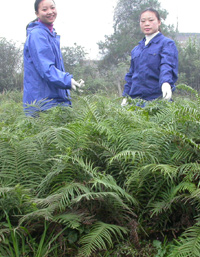
Two researchers stand in a field of Chinese brake fern at the research base in Shimen Country, in Hunan Province, where the largest deposit of ruby arsenic in Asia is located. [file photo]
The plant, known as Chinese brake fern, has been found to be able to absorb arsenic from soil in a highly efficient way.
Research found the plant species can absorb hundreds of thousands of times more arsenic from soil than other plants do.
Conventional ways of cleaning soils contaminated with toxic substances include chemical washing and the substitution of new soil. The soil and sediments removed are buried elsewhere in a way that prevents the pollutants from leaking out.
For many sites, the enormous size of the contaminated areas, and hence the huge cleanup costs, make this approach unfeasible. Unlike air pollution, soil contamination is relatively difficult to monitor and to get rid of once it has occurred. "Soil often gets contaminated without human knowledge and it's often too late to do anything when it is discovered," Chen said.
Take arsenic contamination for example. Chen said smelting arsenic ores is a traditional industry in many places in Hunan, yet there is still no co-ordinated network to monitor the disposal of the slag.
"It is often after soil contamination has affected some people that the slag source is tracked down, when large areas of soil and water have already been seriously contaminated," Chen said.
The discovery of the special capability of Chinese brake fern sheds new light on treating the contaminated soil in a cost-effective way.
Chen and his colleagues at the Institute of Geographic Sciences and Natural Resource Research in Beijing discovered the unique capability of the plant at almost the same time as an American research team five years ago. It is the first plant species found in China that has the capability of accumulating toxic chemical substances in substantial amounts. Since then, they have been developing ways to clean up arsenic polluted soil by planting brake fern.
"It is probably one of the most common green plants in southern China," Chen said, "yet its ability to absorb arsenic had not been noticed by anyone, including myself."
He said he and his colleagues had noticed the plant around their research center for quite a long time, but had no idea of its hyperaccumulating capability until they started research on cleaning up contaminated soil using plants.
Forefront research
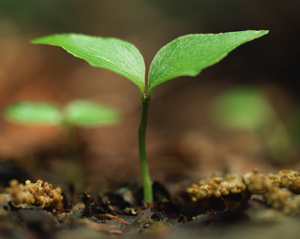
Plants evidence an amazing ability to adapt to different environments. [file photo]
The process, formally known as phytoremediation, has become a forefront research area worldwide during the last decade. More and more scientists have focused attention on using plants that can accumulate and degrade organic pollutants or contain and stabilize metal contaminants by acting as filters or traps.
It has been estimated that more than 400 species of plants naturally take up various metals and trace elements, including nickel, arsenic, cadmium, chlorine and selenium. Some species, known as hyperaccumulators, absorb various noxious substances in substantial amounts.
Apart from the Chinese brake fern, sunflowers, for example, can remove radionuclides from water and have been used to soak up radioactive elements near nuclear power plants that have been shut down.
Chen had done research on arsenic before moving into the area of phytoremediation in the hope of finding a plant species that could clean arsenic contaminated soil. He believes that the hyeraccumulating capability of certain plants may probably be the evolutionary result of their adaptation to the environment. That is, the hyperaccumulating plants are probably more likely to be found where pollutants exist in large quantities.
Consulting a map showing arsenic distribution in the country, Chen decided to focus his research on Shimen County, in Hunan Province, where the largest ruby arsenic mine in Asia is located. Arsenic mining started 1,500 years ago and pollution has gone from bad to worse.
Chen and his colleagues collected over 200 plant species near the left-over arsenic slag, including Chinese brake fern, and brought their collection back to Beijing for testing.
They found that the brake fern contains over 1,000 milligrams of arsenic per kilogram on average, compared with the average level of 3 milligrams per kilogram in other plants.
They also found that unlike other hyperacummulating plants already found, the arsenic concentration in the leaves of the fern is much higher than in the stalk and the root, which suggests the arsenic has been absorbed and carried upward.
Tests on the brake fern they grew in their labs showed that it was more capable of accumulating arsenic than the wild plant and that the concentration increased steadily with time.
The quest to unlock the mechanism of hyperaccumulating capability has been under way ever since it was discovered in certain plants.
Some scientists suggest these plants may convert the substances to less toxic metabolites by metabolizing available nutrients in toxic substances, and may also stimulate the degradation of organic chemicals around their roots by the release of root exudates.
Exactly what these plants do and how they do it remains, for the most part, a mystery; and nobody knows why they do it, so far. A popular theory is that they absorb toxins for self-defence so that pests don't find them tasty or for nutrition, for instance.
But Chen admitted that these theories remain to be verified.
While research efforts into the inner workings of hyperaccumulating plants continue, the work on bioengineering fast-growing plants to clean up the pollutants has begun.
Chen's team established an experimental zone in Shimen two years ago, where they grew brake ferns to clean up the soil contaminated by arsenic.
The ferns have been growing well in the arsenic-intensive soil and have been steadily reducing the contamination.
"The fern itself grows fast and needs to be reaped several times a year," Chen said, "It is the perfect tool to accumulate the arsenic on a continuing basis."
He expects the soil to be suitable for farming in two years time. If the field trial succeeds, the technology can be put into practice.
And research on the hyperaccumulating mechanism itself will definitely continue, he said.
(China Daily April 7, 2004) |
| Tools: Save | Print | " target="_blank" class="style1">E-mail | Most Read |
 |
| Related Stories |
|
