 Share:

A major international initiative aimed at using advanced digital technologies to accelerate progress toward achieving the sustainable development goals (SDGs) was launched at the 2025 World Science and Technology Development Forum (WSTDF) in Beijing on Oct. 28.
The Digital Earth Initiative for the Sustainable Development Goals was unveiled during a thematic session focused on leveraging Digital Earth technologies for sustainable development. It represents a renewed commitment from the global Digital Earth community to transform complex data and knowledge into informed, transparent and ethical decision-making for advancing the United Nations' SDGs.

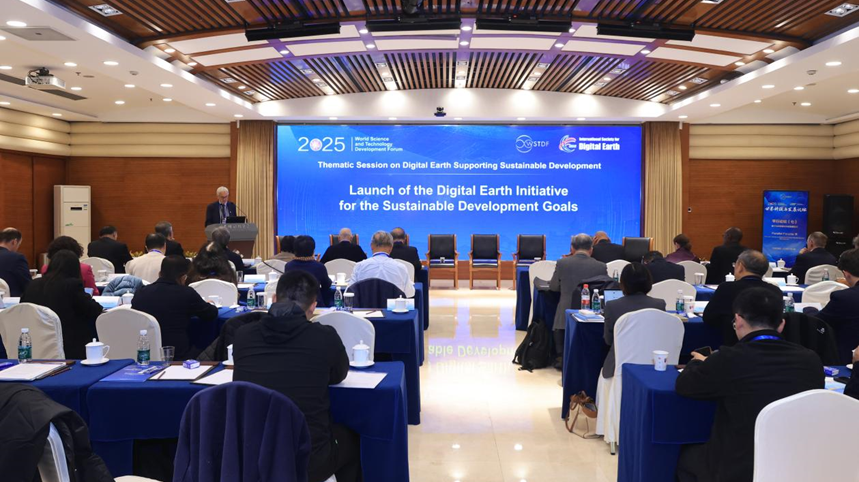
The launch event for the Digital Earth Initiative for the Sustainable Development Goals in Beijing, Oct. 28, 2025. [Photo provided to China.org.cn]
The initiative is built on the philosophy of treating SDGs "not as static targets but as dynamic relationships among climate, water, energy, nature and society," making cross-cutting digital technologies even more crucial for finding integrated solutions.
Adopting the framework of the International Society for Digital Earth (ISDE) — Digital Earth as a Strategic Intelligence and Decision Theatre — the initiative promises to establish pilot theaters across priority SDG domains while strongly upholding principles of ethical governance and transparency.
The session drew approximately 70 leading figures and representatives from research institutes and universities across 19 countries, alongside relevant U.N. agencies and international organizations. Its core aim was to respond to the growing global call for a paradigm shift in digital technologies, particularly at the intersection of big data, artificial intelligence and Earth sciences, to eliminate data and technology barriers and help narrow the gaps in achieving the SDGs.
In his welcome remarks, Richard Simpson, president of the ISDE, conceptualized Digital Earth as a federated infrastructure of cyber-physical systems, rather than a monolithic platform. He explained that the infrastructure's purpose is to enable planetary-scale understanding by integrating capabilities to sense, simulate and coordinate global data.
Keynote speakers at the session offered in-depth looks into the potential of GeoAI, big Earth data and geospatial toolkits to overcome current gaps in SDGs.
The session also highlighted themed panel discussions, which closely examined the innovative uses of Digital Earth technologies and the key principles to guide more informed stewardship of geospatial tools for both accelerating and elevating the quality of SDG outcomes.


 京公網安備 11010802027341號